Thursday, February 10, 2022

"Prairie de Jacko": Source of the Name?

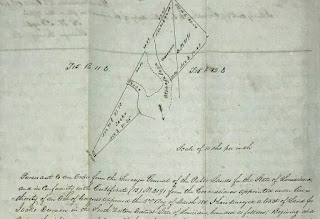
I recently noticed an old Louisiana land document for sale on eBay. It concerned property located near the confluence of Bayou Teche and the Atchafalaya River. (What is called Bayou Teche on this map is today called the Lower Atchafalaya, the Teche now regarded as flowing into the Lower Atchafalaya at Patterson.)

The old Louisiana land document.
(Source: eBay.com)

In other words, the document concerns land near the present-day community of Baldwin, across the Atchafalaya River from present-day Morgan City. 

Note the document’s hand-drawn map. Written across parcels spanning both "Bayou Teche" and the Atchafalaya is the name "Jacko Derouen." (Yes, Jacko, as in Michael Jackson’s nickname — though I expect the south Louisiana "Jacko" would have pronounced his name the French way: ZHAH-KO.) Jacko Derouen’s full name also appears below the map, in the actual text of the document.

Close-up of the hand-drawn map.
(Source: eBay.com)

I believe this document answers a question of mine I’ve had for some years: Why in the 1700s was an expanse of land in that region called "Prairie de Jacko"?

From my previous research I knew the toponym appeared in Thomas Hutchins’ 1784 book An Historical Narrative and Topographical Description of Louisiana and West-Florida. In that work Hutchins stated "3 miles below the Tage [Teche] river on the western side is a large savanna known by the name of Prairu de Jacko [Prairie de Jacko]. From this savanna is about 33 miles to the sea."

Page detail from Hutchins' 
An Historical Narrative (1784).
(Source: University of Florida)

Another reference appears on Hutchins’ presumably earlier hand-drawn map of the Teche region. Found not in a Louisiana archives, but in the holdings of the Historical Society of Pennsylvania in Philadelphia, that map — which I believe Hutchins drew between 1779 and 1784 — shows the scrawled placename "Prari[e] de Jacob."

Hutchin's upside-down map (detail).
(Source: Historical Society of Pennsylvania)

The name also appears in the 1779 journal of François Gonsoulin, who, though French in origin, served in Louisiana as a Spanish royal surveyor (the colony having passed from France to Spain in 1762-63). The Spanish government had tasked Gonsoulin, along with local Flemish settler Jean-Baptiste Grevemberg and several enslaved rowers, with exploring the course of the middle and lower Bayou Teche. They would travel downstream from newly founded New Iberia (then called Nueva Iberia) to the bayou’s mouth — a stretch that not only included the present-day Teche below New Iberia, but the waterways now considered the Lower Atchafalaya and the Atchafalaya itself. Even then this was a matter of contention. As I wrote in my 2016 book Teche: A History of Louisiana’s Most Famous Bayou (University Press of Mississippi): 

Indeed, he [Gonsoulin] bristled at those like [colonial leader] Bouligny who called the Lower Atchafalaya "el Rio Grande" or in French "Grand Rivière." They spoke "inappropriately," asserted Gonsoulin in his diary. On the contrary, the great river, he insisted, was "always the Teche."

In my Teche book I also included the below passage about Gonsoulin’s 1779 exploration of the bayou and its distributaries: 

The falua [a type of boat] passed a flat grasslands, which Gonsoulin identified as "la Prairie à Jacob," or Jacob’s Prairie. (This is the same stretch Hutchins had called the Prairie de Jacko and the Prairie de Jacob.) 

Cover of my book Teche.

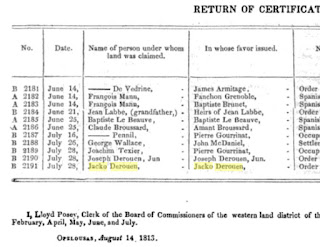
I assume the "Jacko" or "Jacob" mentioned by these early sources is none other than Jacko Derouen. This seems likely, given the peculiarity of the name Jacko: unlike the surname Derouen (commonly found in present-day south Louisiana), the "prénom" Jacko certainly strikes me as unusual, perhaps even unique, for the time and place in question. It could, however, be a diminutive, a corruption, or simply a misspelling of the common name "Jacob" — as the name is indeed rendered by Gonsoulin — or its French equivalent "Jacques." (There is indeed a Jacques Derouen mentioned in early 19th-century historical documents pertaining to south Louisiana.)

Page detail from
the American State Papers (1834)
re: Jacko Derouen’s land in 1813.
(Source: Google Books)

Unfortunately, I know little about Jacko Derouen himself. 

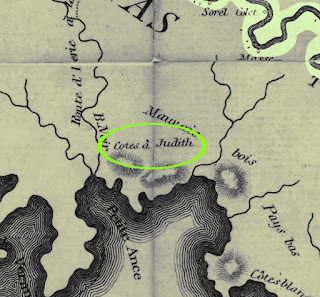
It does seem a little odd that a prairie should bear the first name of a local settler, rather than their surname. This is, however, not the only such instance of this practice. Barthélémy Lafon’s 1806 map of Louisiana, titled Carte générale du territoire d’Orléans comprenant aussi la Floride Occidentale et une portion du territoire du Mississipi, identifies the two salt domes now called Avery Island and Weeks Island as the "Cotes à Judith" (which I would translate as "Hills [Côtes] of Judith" or "Judith’s Hills"). As with "Jacko," I assume "Judith" is a first name.

Regardless, I have never been able to identify the namesake for "Cotes à Judith," and I now wonder if Lafon did not merely garble the surname "Judice." That surname was present in south Louisiana by the 1730s and today is fairly common in the region. Indeed, this solution seems even likelier when one considers that in French, more so than in English, "Judith" sounds remarkably like "Judice."

No doubt there is more out there to be found about these two south Louisiana toponyms.

The "Côtes à Judith"
from Lafon's 1806 map;
Bayou Teche shown at upper right.
(Source: Library of Congress)


Saturday, January 11, 2020

Notes on the Founding of Opelousas

History is, like science, a self-correcting discipline: professional historians make their careers in part by correcting or refining the research and assertions of other historians. This is a laudable practice and should be encouraged — even by historians whose own research is called into question and perhaps refuted. As I myself am fond of quoting, "No one who cannot rejoice in the discovery of his own mistakes deserves to be called a scholar."


What does Shakespeare
 have to do with Louisiana history?

This quote comes from noted Shakespeare scholar Donald Foster, who in 2002 recanted his own claim that the Bard of Avon had authored an anonymous poem titled "A Funeral Elegy." As the New York Times reported, "Now, in a stunning development that has set the world of Shakespeare scholarship abuzz, Professor Foster has admitted he was wrong." To me, such an admission is nothing but praiseworthy. It's how scholarship should work.

This brings me to an issue far removed from the world of British poetry — to a seemingly minor issue that nonetheless has garnered regional media attention in south-central Louisiana: namely, was the town of Opelousas, Louisiana, founded in 1720 as sometimes asserted in tourism brochures, on city welcome signs, and on the Internet, among other places?(1) Or was it founded later, as claimed by several professional and avocational historians, including Dr. Claude F. Oubre of LSU Eunice, Dr. Carl A. Brasseaux of UL Lafayette, genealogist Winston De Ville, independent researchers John Harper and Donald J. Arceneaux (the latter four of whom I thank for proofing this essay), and myself?

In truth, I have never seen any evidence to indicate that Opelousas was founded in 1720 or, for that matter, any time before the mid- to late-eighteenth century. And by "evidence" I don't mean twentieth-century or early twenty-first-century published secondary-source material, such as a book of local history, an encyclopedia entry, a magazine article, or a city government website. I mean primary-source evidence from or around 1720, such as a handwritten colonial document in French or Spanish.


Random example of a primary-source
document from the colonial era.

By the time of Opelousas' alleged 1720 founding, New Orleans had existed for only two years, and the entire Louisiana colony, for a mere twenty-one years. The region surrounding and adjacent to present-day Opelousas (that is, modern south-central and southwestern Louisiana) was during the early to mid-1700s a sort of no-man's land claimed by both France and Spain. In fact, Spain located the capital of its Mexican province of Texas in what is today Louisiana (at Los Adaes near Natchitoches, Louisiana, some 110 miles to the northwest of present-day Opelousas).

Because France and Spain were allied Bourbon monarchies with a common perennial enemy — namely, Britain — the two Empires mutually refrained from settling the disputed region. In this way, reasoned French and Spanish administrators, they could avoid antagonizing each other.


Attakapas Indian,
by Alexandre de Batz (1735).
Source: Wikimedia.org

There was another reason France and Spain avoided incursions into the region: fear of the reputedly cannibalistic Attakapas Indian tribe (whose very name, given to them by other, rival tribes, means "Man-Eater").(2) It is uncertain if the Attakapas were actually cannibals, but it hardly mattered to colonial-age settlers: they believed the Attakapas were cannibals, and that was enough to curtail settlement in the region. In fact, the French in Louisiana rarely wandered from the protective banks of Louisiana's great river system. As a result, most French activity in colonial Louisiana occurred right along the shores of the Red and Mississippi rivers.

It thus would have been surprisingly early, and extremely incautious, for the French to have settled the town of Opelousas in 1720And yet it nevertheless has been widely stated that the French did precisely that. The year even appears on the City of Opelousas' official seal.(3)


Seal of the City of Opelousas.

The claim also shows up — to cite only a few of a great many published examples — in Fodor's 2000 travel guide to the U.S. It states "Opelousas is the third-oldest town in the state" because it was "Founded by the French in 1720. . . ." Likewise, the New Encyclopedia Britannica observed in 1974 that Opelousas had been "Founded in 1720 as a French garrison and trading post. . . ." In 1954 the Louisiana Municipal Review magazine asserted "History shows that enterprising French adventurers operated a permanent trading post with the friendly Attakapas Indians on the site of present day Opelousas as early as 1720. . . ." 

Unfortunately, none of these sources cite a primary (original colonial-era) source. So what primary-source evidence is there for the 1720 date of origin?

As far as I know, there is no such evidence . . . except for one document that I believe might be the source of an erroneous 1720 date. That document is the French-language Carte de la Louisiane et du Cours du Mississipi by Guillaume de l'Isle, printed in 1718 and used shortly afterwards as the basis for John Senex's English-language Map of Louisiana and of the River Mississipi, printed in 1721. Both maps could be said, therefore, to have been printed "around 1720."(Mississipi, by the way, is an archaic, colonial-era spelling of the modern Mississippi.)


Guillaume de l'Isle, Carte de la Louisiane
et du Cours du Mississipi (1718).
Source: Library of Congress

Those two very similar maps depict the entire eastern half of North America, from the Rocky Mountains in the west to the Atlantic Coast in east. De l'Isle and Senex's maps also encompass parts of Spanish Mexico, French Louisiana (when the name "Louisiana" denoted about one-third of the entire North American continent), and the British colonies from the Carolinas to New York.

A close look at the section of de l'Isle's map covering littoral south-central and southwestern Louisiana reveals the caption "Indiens errans et Antropophages" — in English, "Wandering Man-Eating Indians." And there, right above the word "Antropophages," is the intriguing word "Loupeloussa".


"Wandering Man-Eating Indians,"
detail of the 1718 de l'Isle map.

I believe it is this word "Loupeloussa" that some unknown or forgotten historical researcher, perhaps decades ago, misinterpreted as referring to the town of Opelousas. But it is not a reference to the town. Rather, it is a reference to the Indian tribe after whom the town was eventually named.

We can be certain of this for two reasons:

First, the intriguing map label in question reads "Loupeloussa" – that is, "L'Oupeloussa", or in English translation "The Oupeloussa". This combination of the French article "L'" with the tribal name "Oupeloussa" indicates that de l'Isle applied the term not to a settlement, but to a group of people: the Oupeloussa tribe. De l'Isle did likewise on the map for many other (though not all) Indian tribes, as when he labeled "Les Cheraqui" (The Cherokee) and "Les Chicachas" (The Chickasaw), to name only two of many such instances.


Other tribes identified
on de l'Isle's map.

Second, just below the "L" in "Loupeloussa" appears a diminutive symbol that looks like a house or other dwelling. De l'Isle expressly states in the key to his map that this symbol denotes "Habitations des Indiens" — Indian habitations. Not colonial settlements founded by Europeans and Africans, but Native American villages.


Key to de l'Isle's map.

One might assert that the Native American village labeled "Loupeloussa" could have evolved into the modern-day town of Opelousas. This, however, is clearly not the case: both the word "Loupeloussa" and its accompanying symbol appear on de l'Isle's map next to a bayou flowing a short distance, and directly, into the Gulf of Mexico. The modern-day town of Opelousas, however, is not located a short distance from the Gulf of Mexico (St. Landry Parish, in which the town sits, being landlocked); nor does the town sit on a notable bayou (local bayous Yarbor and Tesson, for example, being little more than cement-lined coulées [ravines] inside the city limits); nor does the town sit on a bayou flowing directly into the Gulf of Mexico. (The two most notable bayous near but not in Opelousas — namely, the Teche and the Courtableau — likewise do not flow directly into the Gulf of Mexico. Instead, they run more or less southeasterly into the Atchafalaya River and its distributary, the Lower Atchafalaya River.)


"Loupeloussa" label and its dwelling symbol
on the "Rio Mexicano,"
detail of the 1718 de l'Isle map. 

On even closer inspection of de l'Isle's map, we see that the waterway on which the cartographer placed "Loupeloussa" and its dwelling symbol is labeled "R. Mexicano" — that is, Rio Mexicano (or in English, the Mexican River). As I note in my 2016 book, Teche: A History of Louisiana's Most Famous Bayou (Jackson: University Press of Mississippi), "[A]t one time or another the [colonial] Spanish referred to the present-day Sabine and Mermentau rivers . . . as the Rio Mexicano (Mexican River)." Thus, it appears de l'Isle placed the "Loupeloussa" tribe and its village on the Mermentau (the Sabine being too far west in this instance to consider). And the Mermentau, interestingly, does indeed flow directly into the Gulf.


John Senex's English-language map,
based on de l'Isle's earlier one (1721).
(Source: Library of Congress)

To summarize my analysis thus far: de l'Isle's circa 1720 map does not refer to the town of Opelousas, but to a village occupied by the Indian tribe called the "Loupeloussa," from whom the modern-day town — eventually founded some forty miles to the northeast — acquired its name.

The tribe similarly gave its name to the Poste des Opelousas, a term referring not, as often believed, to a single village or outpost or garrison, but to the entire southwestern corner of Louisiana now embracing St. Landry, Calcasieu, Cameron, Beauregard, Allen, Jefferson Davis, Evangeline, and Acadia parishes.


Detail of Senex's English-language map (1721),
based on 
de l'Isle's earlier one.

It would be several more decades, I believe, before settlers of European and African heritage founded a town called Opelousas. That event must have occurred some time after the mid-1700s. (When precisely the town came into existence I might explore in another essay.) I say this because, as far as anyone knows, the earliest permanent settlers in all south-central and southwestern Louisiana (that is, excluding wandering traders like Joseph Blanpain, who passed through but did not remain in the region) were the French pioneer Andre Massé and his enslaved Africans. And according to Massé's own correspondence, he arrived in the region in or before 1746. Indeed, an 1809 document now in the Louisiana State Land Office, signed by planters Joseph Sorrel and Claire Dauterive Dubuclet, testifies that "André Massé was the first person who settled in this part of the country. . . ."


"André Massé was the first person. . . .":
the Sorrel-Dubuclet document (1809).
Source: Louisiana State Land Office

If that is the case, no non-indigenous peoples settled in the region adjacent to and including modern-day Opelousas until Massé appeared on the Teche around 1746. For this reason — along with French and Spanish political concerns, widespread fear of the Attakapas tribe, and the apparent misinterpretation of de l'Isle's map — it seems to me incredibly doubtful that the town of Opelousas was founded any time before the region passed uncontested to Spanish control in 1762. 

A serious question remains: is there some other colonial-era, primary-source evidence — evidence I might not know about and so have not considered — proving that Opelousas was founded in 1720? If so, I would very much like to see it and, if conclusive, adjust my view accordingly. 

"It is vital, however (and I cannot stress this enough), that researchers distinguish between historical references to the Opelousas tribe, the Poste des Opelousas political district, and the later town of Opelousas. I say this because they are not the same thing, but could be confused with one another."

It is vital, however (and I cannot stress this enough), that researchers distinguish between historical references to the Opelousas tribe, the Poste des Opelousas political district, and the later town of Opelousas. I say this because they are not the same thing, but could be confused with one another. It would be easy, for example, to mistake a reference to the Poste des Opelousas district for a reference to a village or outpost or garrison called Opelousas. As I mentioned, however, the Poste was not a single small point on a map, but rather the entire southwestern part of the present-day state of Louisiana.


The old Poste des Opelousas region.
(Click to enlarge)
Source: William Darby, A Map of the State of Louisiana
with Part of the Mississippi Territory (1816).

Ultimately, if there is no indisputable primary-source evidence for the 1720 date, I suggest the claim, in the best tradition of scholarship, be acknowledged as incorrect and discarded. There would be no shame in this, only merit.


Notes


(1) The media broached this issue, for example, twenty years ago in Henri LeJeune, "Date Set on City's Seal May Not Match History," (Opelousas, La.) Daily World, Special Millennium Edition, 1 January 2000, pp. 1A, 3A; see also Bobby Ardoin, "Opelousas Planning 300th Birthday Celebration, Despite Dispute over City's Founding," (Opelousas, La.) Daily World, 4 January 2020, www.dailyworld.com/story/news/2020/01/04/opelousas-officials-schedule-300th-birthday-celebration-despite-dispute-over-citys-founding/2807156001/, accessed 14 January 2020.

(2) Tribal members today sometimes go by the name "Atakapa Ishak," the latter term being their traditional name for their own tribe (as opposed to "Attakapas," the name given them by other tribes).

(3) J. A. Allen, who designed the city seal in 1961, told the Daily World newspaper in 2000 "that originally he had placed the date of the founding of the city at 1764," but at others' urging he changed the date to 1720 even though, explained the newspaper, "there was no specific document that could be found to place the date . . . [of the founding] of the city. . . ." LeJeune, "Date Set on City's Seal May Not Match History," p. 3A.


Quoted Sources


Shane K. Bernard, Teche: A History of Louisiana's Most Famous Bayou (Jackson: University Press of Mississippi, 2016), 11.

Declaration of Joseph Sorrel and Clair Dauterive Dubuclet, [19 January (unclear, could read "February")] 1809, in Claim Papers S.W.D. [Southwestern District], T.14S. R.6-8E. & T.14S. R.9E. 58, Louisiana State Land Office, document no. 510.00174, Baton Rouge, La., https://wwwslodms.doa.la.gov/, accessed 4 September 2018. 

Fodor's 2000 USA (2000), 483.

Louisiana Municipal Review, Vols. 22-23 (1958), 15.

The New Encyclopedia Britannica Volume 7 (1974), 545.

William S. Niederkorn, "A Scholar Recants on His 'Shakespeare' Discovery," The New York Times, 20 June 2002, www.nytimes.com, accessed 12 January 2020.


Thanks to UL Lafayette public history intern Stephanie Simon for proofing this essay.

Friday, December 27, 2019

When Jimi Hendrix Appeared on My Father's Live TV Show in Lafayette, Louisiana, January 1965

As a caveat, please read the addendum of 9 December 2020 at bottom, which documents a polite challenge to the claim that Jimi Hendrix appeared on my father's TV show. I still believe Hendrix appeared on the program and in the image capturing the event, but, in all fairness, the dissent is worth noting. — SKB


I am indebted to Steve Rodham of the Jimi Hendrix fanzine Jimpress for permitting me to reprint my below article from the Summer 2020 issue (Issue 117). I have added additional images and adapted the article's style and formatting to this blog. Back-issue and subscription information for Jimpress can be found here. I am also obliged to noted Hendrix scholar Joel J. Brattin, professor of English at Worcester Polytechnic Institute in Massachusetts, for sharing his research with me and for putting me in contact with Steve at Jimpress. Finally, I thank Brett Judice, Danny Alvarado, and KLFY-TV 10, Lafayette, La., for providing me with a high-resolution scan of the photo that inspired this article.


The Summer 2020 issue of Jimpress,
the Jimi Hendrix fanzine.


HIDDEN IN PLAIN SIGHT:
“A MILLION MILES AWAY . . .
AND RIGHT HERE IN YOUR PICTURE FRAME”* —
A PREVIOUSLY UNNOTICED JIMI HENDRIX PHOTOGRAPH, 1965

*lyric excerpt from Jimi Hendrix, "Voodoo Chile," Electric Ladyland (1968).

by Shane K. Bernard

In early 1965, an as-yet-unknown Jimi Hendrix appeared on my father's weekend teen-age dance program called Saturday Hop. Hendrix, however, did not sing or play guitar on the show. As far as anyone knows, he merely stood there, at attention, dressed as a British soldier of the "Queen's Guard" (to use the unit's formal name). He wore a dress tunic, dark pants, and a tall bearskin hat. Fortunately, a black-and-white still photograph captures the occurrence — but only in late July 2019 did anyone realize Hendrix appeared in that image. Until then, his presence there, at that time, in that TV studio, in that fantastic costume, was entirely unknown. How this photographic revelation came to be is a complicated story — one that takes some time for telling and for Hendrix to take center stage.


The Photograph. Little Richard and Jimi Hendrix on the set of my father's live TV dance program, 1965. Hendrix is the faux British guard at far left. (Courtesy Brett Judice, Danny Alvarado, and KLFY-TV 10, Lafayette, La.)

In orange lingerie?

The story began, for me at least, in mid-March 2017 with an unexpected phone call from best-selling crime-fiction novelist James Lee Burke. His imaginary Cajun detective, Dave Robicheaux — played on the big-screen by Alec Baldwin and Tommy Lee Jones — routinely solves crimes in and around the real-life town I call home, New Iberia, Louisiana.


James Lee Burke's first novel,
The Neon Rain (1987).

As a fellow writer (I pen non-fiction) I claim only to be an acquaintance of Burke. I've never met him in person, but we've corresponded or spoken by phone a few times over the years. Oddly, we've never discussed writing and on that occasion two years ago we spoke about music. It was then that Burke related this story: in the mid-1960s, long before he published his first novel The Neon Rain (1987), Burke worked in Lafayette as a reporter for the Daily Advertiser newspaper. At that time, my father, "swamp pop" musician Rod Bernard — who scored a national hit in 1959 with the ballad "This Should Go On Forever" — held day jobs as both a deejay and program director at KVOL 1330 AM of Lafayette. 


Rod Bernard performing on the Saturday Hop
set, poster advertisement, ca. 1965.
(Author's collection)

Every Saturday, however, Dad hosted an American Bandstand-style live-TV dance program variously called Saturday Hop, The Rod Bernard Show, and later The Shondells (after Dad's band, not to be confused with Tommy James' better-known group of the same name). Burke explained that Dad once managed to snag a performance by Little Richard, who had come to Lafayette for a live concert elsewhere in town. When Dad introduced Little Richard to the teen-aged dancers and to the viewers at home, the flamboyant rock 'n' roll icon, surrounded by an adoring, flag-waving entourage, promptly marched onto the low-budget set dressed in women's clothing. As I recorded after my conversation with Burke: "Little Richard came out dressed in drag, wearing orange lingerie and earrings, and behind him was his 'posse,' dressed in bellhop uniforms and waving an American flag in one hand and a Little Richard flag in the other."(1)


Dad and fellow swamp pop vocalists Warren Storm (center)
and Skip Stewart (right) on the Saturday Hop set, ca. 1965.
(Author's collection)

Now this was the mid-1960s in south-central Louisiana: the deepest of the Deep South. A place where Brown v. Board of Education would not be heeded until around 1969 — about fifteen years after the U.S. Supreme Court issued that decision ostensibly ending segregation throughout America. Certainly, thought Burke as he watched the show unfold on TV, this would not go down well with Lafayette's many white, generally conservative inhabitants.


Little Richard on Dad's show, 1965.
(Courtesy Brett Judice, Danny Alvarado,
and KLFY-TV 10, Lafayette, La.)

On the Monday after the show Burke called my father and asked if KLFY had received any complaints. "No," Dad replied, "there had been no complaints" — meaning, he added, Lafayette viewers were either unconcerned about the spectacle "or no one watches my show."

The wonder of social media

In July 2019, more than two years after Burke told me this story, a life-long friend, Alan Benit, sent me a screen shot of a photo that, to my astonishment, captured that very appearance — Little Richard lip-syncing on Dad's show. Alan had spotted the black-and-white image in a recent Facebook posting by Cecil Doyle of KRVS 88.7 FM, a public radio station at the University of Louisiana at Lafayette. Doyle had originally posted the image on Facebook in 2010. He, in turn, had obtained it at least nine years earlier from music scholar and Lafayette native Ryan Brasseaux (now on faculty at Yale University). Brasseaux cannot offhand recall his source, but a print of the image hangs in KLFY's lobby — the same station that broadcasted my father's show in the 1960s. And that print may very well be the ultimate source of the digital image circulating on the Internet.(2)


Local swamp pop/soul band Lil' Bob & the Lollipops,
 on the set of Saturday Hop, ca. 1965.
(Courtesy the Johnnie Allan Collection,
 Acadiana Manuscripts Collection,
University of Louisiana at Lafayette)

Regardless of provenance, no one seemed to realize that an entertainer even more legendary than Little Richard appeared in the image. It certainly did not come to mind on my first viewing: I thought only of Burke's story, with its references to bellhops and orange lingerie. Clearly, I reasoned, Little Richard and his entourage had either changed costumes during the program — quite an effort for a regional show in a small to medium market — or Burke had misremembered, and there had been no bellhops or orange lingerie. But one cannot fault Burke: already in his 80s when we spoke, the novelist was, after all, recalling an obscure event from over a half-century earlier. Besides, Burke's memory contained more than a grain of truth: Little Richard had, as usual, dressed extravagantly for the show (albeit in dark slacks and a shiny lamé jacket), and his entourage had, in fact, carried flags and worn uniforms. (Moreover, early in his career, Little Richard had indeed performed in drag.)(3)

I soon posted the Little Richard image on my own Facebook page, dedicated to south Louisiana history. I also posted photographs from the period showing my father and other musicians on the same dance program set. And clearly it was the same set: the theatrical "flats" (oblong wooden frames covered in canvas) sporting musical motifs — a trumpet here, a guitar and a musical note there — were definite giveaways. A careful study of those images, including the one featuring Little Richard, reveals that some of the flats had been autographed by Dad's musical guests. (One can only wonder what happened to all those autographs.)


Dad performing on the set of Saturday Hop, ca. 1965.
(Author's collection)

Hendrix – on Dad's show?

The Little Richard image proved extremely popular on my Facebook page and attracted the attention of Scott Longon. As is often the case on social media, I'd never met Scott and, in fact, I didn't know anything about him. Regardless, Scott saw the Little Richard image and in response posted this intriguing question: "Shane, could the picture be from January 1965 when Jimi Hendrix was playing in Little Richard's back[ing] band?" Scott followed up with the comment, "Hard to tell if Hendrix is in the picture with those hats" — referring to the tall bearskin hats of the Queen's Guard. Scott was skeptical, posting again a short time later, "Well, further research indicates the guys in the uniforms were extras and not with the band."(4)

But I was not so sure: I scanned the faces of those ersatz British guardsmen standing stiffly at attention around Little Richard. And it struck me: Jeez, that guardsman on the far left sure as hell looks like Jimi Hendrix!


Detail of Hendrix in British guard uniform,
Dad's show, 1965. (Courtesy Brett Judice,
Danny Alvarado, and KLFY-TV 10, Lafayette, La.)

It was Jimi Hendrix — at that time spelling his name Jimmy Hendrix and performing under the pseudonym Maurice James. And despite initial doubts, it was Scott who had found crucial evidence proving, or almost proving, it was Hendrix. As unlikely as it seems, Hendrix's official Facebook page had once posted, and still had in its timeline, front and back scans of a postcard Hendrix had mailed to his father from Lafayette. Postmarked January 25, 1965, and advertising the Lafayette Holiday Inn (only six months earlier the Civil Rights Act had guaranteed black Americans equal access to public hotels), the postcard read in Hendrix's own hand, "I'm playing with Little Richard. . . . We're in Louisiana now."(5)


Postcard mailed by Hendrix from Lafayette, La.,
on January 25, 1965.
(Source: Jimi Hendrix Facebook page)

That postmark date, January 25, 1965, happened to be the same day Little Richard played a concert in Lafayette. This show fell three days after "Little Richard and his Royal Show" had performed at the Bamboo Club in not-too-distant Lake Charles, Louisiana — and only two days after Little Richard could have appeared (with Hendrix in tow as a British guardsman) on Dad's live Saturday TV show broadcasted from Lafayette.


Advertisement, Lake Charles American Press,
January 22, 1965.

Incidentally, no ads for Little Richard's Lafayette show of the 25th appeared in newspapers, perhaps because it was, as a German fan site records, a strictly "Private Function." Someone who attended the show, however, recounts it took place at a recreation hall run by Immaculate Heart of Mary, a Catholic church serving primarily African American congregants. The church property sat then, as it does today, on the corner of Surrey and 12th streets in Lafayette.(6) (See below Addendum of 19 October 2020.)


Immaculate Heart of Mary, corner Surrey and 12th, Lafayette, La.
(Source: Google Maps)

To further remove doubt about the image actually showing Hendrix, one need only consult Joel J. Brattin's article in the June 2011 issue of UniVibes. In that issue Brattin — a professor of English at Worcester Polytechnic Institute and a noted Hendrix scholar — published a fuzzy screen shot of Hendrix in a British palace guardsman uniform. As Brattin wrote, "Three of Little Richard's band members (including a 22-year-old Jimmy Hendrix), attired in (red?) uniforms and wearing tall bearskin hats intended to remind viewers of British guards, stand stiffly at attention in the background, never moving at any point."


Hendrix in British uniform
on American Bandstand,
March 6, 1965.
(Source: UniVibes magazine)

Captured nearly six weeks after Hendrix would have been photographed on my father's show, the image Brattin described shows Hendrix with Little Richard on Dick Clark's American Bandstand. Like that image, the newly identified Saturday Hop image of January 23, 1965 (the inferred date Hendrix and Little Richard appeared on Dad's show), will help to flesh out a murky period in Hendrix's life — a period just before his swift rise to true rock 'n' roll royalty. On a more personal level, however, I'm now able, every so often, to glance over at my teen-aged son — himself a budding rock and blues guitarist — and remind him anew each time of the stranger-than-fiction epiphany: "Dude, Jimi Hendrix was on your Paw-Paw's show!"(7)

Addendum of 19 October 2020

Bam Arceneaux kindly sent me this vintage poster image advertising a gig for Little Richard and "The Royal Guards" at New Iberia's long-defunct Oriental Club. The performance was booked for Saturday, January 23 — and, as mentioned, the 23rd did indeed fall on a Saturday that year. So it seems Little Richard played more than one show in the Lafayette area during his early 1965 visit to the area, and would have performed, with Jimi Hendrix on guitar, at the Oriental Club the same day he lip-synced on my father's live TV program in nearby Lafayette.

Poster, Oriental Club, New Iberia, La.
(Courtesy Bam Arceneaux)


Addendum of 9 December 2020

In pursuit of historical objectivity I point out that Caesar Glebbeek, editor of the Jimi Hendrix magazine UniVibes, does not believe the photo of Little Richard at KLFY-TV 10 in January 1965 shows Jimi Hendrix. In emails to me of December 2020, Glebbeek observed, "Just to let you know that in the TV show image, we do NOT see Jimi Hendrix." He added, "Jimi Hendrix was with Little Richard in Lafayette, of course[,] in late January 1965 but as a guitarist [not also as a British guardsman]. . . . [Regarding] the photo at your dad[']s TV show, [it is] NOT Jimi as guard. . . . Jimi was paid by LR [Little Richard] 50 dollars per show, and he would not be going to stand as guard as he was not being paid to do that. It would also be out of character for Jimi to go along with a silly thing like guard[-]standing..."(8)

Rather, Glebbeek asserts that the British guardsman who appears to me to be Hendrix is actually a different person; and that this different person appears in another circa 1965 photo of "Little Richard and His Royal Show" (aka "His Royal Company" and "The Royal Guards"). Here is a comparison of the two images (at left, a detail from the photo taken on the set of my father's show; at right, a detail from the other photo):


The same person or not?

In other words, Glebbeek affirms that Hendrix was in Lafayette playing guitar with Little Richard that weekend in January 1965, but does not believe Hendrix appears in the photo of Little Richard on my father's show taken that same weekend — Hendrix being possibly out-of-frame, back at the hotel, or somewhere else.

I politely disagree, if only because the British guardsman in question looks (in my opinion) not quite like the other, albeit similar guardsman, but he does look (again, in my opinion) exactly like Jimi Hendrix. In fact, I had examined the different circa 1965 photo of "Little Richard and His Royal Show" about a year ago when researching my blog article, and while I noticed a similarity between the guardsman in question and the person I believe to be Hendrix, I did not think it noteworthy because to me they were clearly two different people.

Niko Bauer of EarlyHendrix.com concurs, noting on his website, “[A]ccording to the author [Bernard] the photo features a cameo by Jimi as one of Little Richard's Royal Guards. I agree with him, the person in the picture looks exactly like Jimi Hendrix: the eyebrows, the eyes, the nose, the cheeks, the lips, the chin - even though the picture is a bit fuzzy they all match. He either is Jimi Hendrix or an exact lookalike. Jimi would also later make another cameo appearance as a Royal Guard in an episode of ‘American Bandstand’ broadcast on the 6th of March 1965.”(9)

Incidentally, for what it is worth I ran the images in question through the "Compare-a-Face" app on FamilySearch.org (which is decidedly not what the app is designed for, though as others have pointed out it can be gamed for such a purpose). When I compared the above two British guardsmen images to each other, the match rate was an impressive 99 percent! Could it be, however, that the identical tunic, chin strap, and busby in each image contributed to such a high ranking? One would think not, if the app only looks at faces themselves — but is that even how the app works? I don't know. But I do know that when this third image, which is definitely of Hendrix, is compared to the image of the person on my father's show, the match score is 93 percent. Not too bad.

The only conclusion I can glean from this experiment: that the person in the Saturday Hop photo may or may not be Jimi Hendrix — and I already knew that!

I do, however, concur with Glebbeek's suggestion that "As for the 'private function' in Lafayette, that is wrong info also . . . [A] Mix up with LR's [Little Richard's] days as preacher when he left RandR [rock'n'roll] music." I think this is a real possibility, because it strikes me as odd that a Catholic Church would have sponsored a Little Richard rock'n'roll concert. It would have made more sense for the church to have sponsored a later Richard visit, once he had become a Christian preacher. If so, then the source who remembered attending the concert at the Catholic Church slightly misremembered the event as a rock'n'roll concert instead of a religious event. 

Regardless of all this, we know for certain that Little Richard appeared on my father's TV show on January 23, 1965, and we now know he appeared at the Oriental Club in New Iberia that very same day, undoubtedly with Jimi Hendrix on guitar — events explaining Little Richard's visit to the Lafayette area that weekend over a half-century ago.


Notes


(1) Shane K. Bernard, New Iberia, La., to Shannon E. K. Bernard, New Orleans, La., 5 March 2017, email correspondence.

(2) Cecil Doyle, Facebook posting, 1 August 2019, www.facebook.com, accessed 4 August 2019; Brett Judice, Assistant Chief Engineer, KLFY-TV 10, Facebook posting, ca. July 2019, www.facebook.com, screenshot [image and text] sent to Shane K. Bernard by Alan Benit, 25 July 2019; Ryan Brasseaux, to Shane K. Bernard, New Iberia, La., 12 August 2019, email correspondence.

(3) See for instance Richard Harrington, "'A Wopbopaloobop,'" Washington Post, 12 November 1984, www.washingtonpost.com, accessed 14 August 2019. As Harrington noted, "Little Richard had started his career performing in drag at southern roadhouses. . . ."

(4) Scott Longon, Facebook posting, 29 August 2019, www.facebook.com, accessed 4 August 2019.

(5) Jimi Hendrix Facebook page posting, 25 January 2013, www.facebook.com, accessed 6 August 2019.

(6) Tour information for various musicians including Little Richard, 1965, on the website "Celebrating the Life and Times of Chuck Berry — Mr. Rock 'n' Roll," http://www.mbhomepage-design.de/tour1965.htm, accessed 17 August 2019. This site lists Little Richard as performing at a "Private Function" in Lafayette, Louisiana, on 25 January 1965. Advertisement for "Little Richard and His Royal Show," Lake Charles (Louisiana) American Press, 22 January 1965, p. 1; Francis Pavy, to Shane K. Bernard, New Iberia, La., 31 July 2019, Facebook private message. A noted Lafayette-based visual artist, Pavy is acquainted with a source who attended Little Richard's concert of 25 January 1965 at the church hall.

(7) The local newspaper's TV listings confirm that my father's live dance program, called Saturday Hop, did indeed air on Saturday, 23 January 1965, on KLFY from 12 to 1 p.m. Television listings, Daily Advertiser (Lafayette, La.), 22 January 1965, p. 12.

(8) Caesar Glebbeek, Popiglio, Toscana, Italy, to Shane K. Bernard, New Iberia, La., 7 December 2020, e-mail correspondence.

(9) EarlyHendrix.com, 14 August 2024, http://www.earlyhendrix.com/live-dates#littlerichard23jan1965, accessed 15 August 2024.