
I thank John Broven, C. C. Adcock, Yvette Landry, and Count D. for proofing the below essay in whole or part and offering their insights.
❧
In early August 2021 local media outlets reported that a south Louisiana musical landmark, the Southern Club in Opelousas, had collapsed — putting an end to occasional efforts to preserve the 72-year-old structure as a historical landmark. A month later, swamp pop pioneer Warren Storm died at age 84, having played music almost right up to the end. Indeed, after his death I spotted an Internet ad promoting a show that, had Storm lived, he would have played the very next weekend. A music journalist once quoted Storm as declaring (in what source, I can’t remember), “They’ll have to pry the drumsticks from my cold, dead hands.”(1)
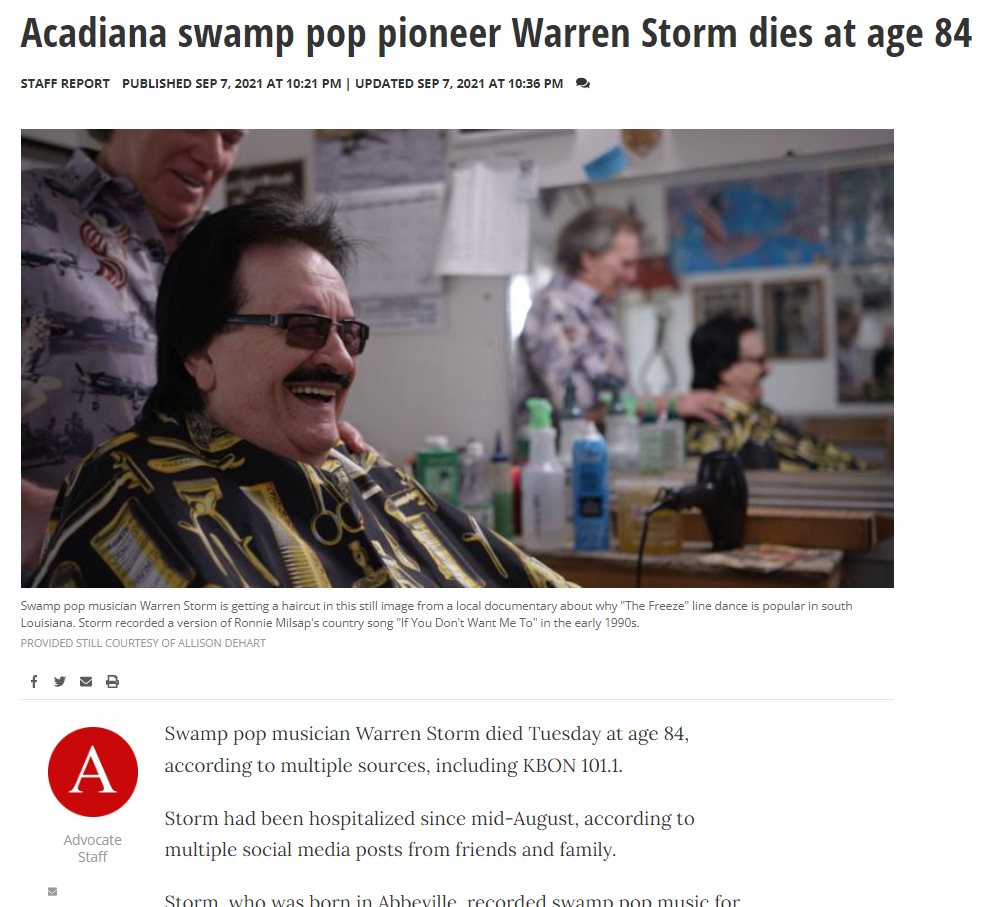 |
| Warren Storm's obituary. Source: www.theadvocate.com |
These two unfortunate events, along with the previous year’s death of my father, swamp pop entertainer Rod Bernard, underscored for me how many first-generation swamp pop performers had passed away since the early 1990s when I interviewed them for my book Swamp Pop: Cajun and Creole Rhythm and Blues (University Press of Mississippi, 1996).(2)

At that time about thirty years ago practically all the major swamp pop originators were still alive — and one, Huey “Cookie” Thierry (of Cookie and the Cupcakes), had seemingly sprung back from the dead. Wrongly believed to have been killed years earlier in a southern California automobile accident, he reappeared in south Louisiana after a twenty-seven-year absence, and just in time for me to interview him for my study. (Five years later he really did pass away at age 61.)
Of the numerous swamp pop artists I interviewed for my book, I count seventeen who have gone to “that big Yesterday’s Lounge in the sky,” as south Louisiana performer C. C. Adcock quipped in a tribute to Storm, his one-time Lil’ Band o’ Gold drummer-vocalist. Those deceased swamp poppers — besides Storm and Dad — include Bobby Charles, Joe Barry, Van Broussard, John Fred, Lil’ Bob, Little Alfred, Clint West, Phil Phillips, and both King Karl and his musical partner Guitar Gable. This list includes only the major lead vocalists and bandleaders, not the many backing musicians, producers, promotors, club owners, and deejays I interviewed who are no longer living — among them producers and record men J. D. Miller, Lee Laverge, and Eddie Shuler, club owner Lionel “Chick” Vidrine, and deejay Buddy King, to name a few. (I should not omit music writer Larry Benicewicz of Baltimore, a swamp pop admirer who documented the sound by interviewing and photographing many of its artists for Bluesrag magazine.)
So how is the swamp pop genre doing today, some six decades after its heyday, with so many fewer of its original music makers?
 |
| An early swamp pop record in 78 RPM format, 1955. |
That heyday spanned roughly 1958 to 1964, ending when the Beatles and other British Invasion acts blindsided the pop music world. Those six years comprised an era when swamp pop (which did not yet bear that name) was not “oldies” music, but a new, youthful, cutting-edge rhythm and blues (or just as easily “rock ‘n’ roll”) idiom made by teenaged Cajuns and black or mixed-race Creoles — a multiracial musical idiom born amid (and despite) the racial segregation of the post-World War II-era South. As I described or attempted to define the sound in my book about the genre:
I consider swamp pop to be a rhythm and blues hybrid that is influenced mainly by New Orleans rhythm and blues, country and western, and Cajun and black Creole music, and that is indigenous to southeast Texas and the [22-parish] Acadiana region of south Louisiana.(3)
I also observed in that book, “Swamp poppers are appearing in public on increasingly fewer occasions. . . .” and noted that “swamp pop — still rarely featured outside south Louisiana and southeast Texas nightclubs — has in recent years attracted only a handful of younger swamp pop artists. . . . “ As my father despaired, “I’m just a little afraid . . . that these beautiful songs might all die with us.”(4)
I’m pleased to say, however, that in my estimation swamp pop music is doing better than ever — or at least better than it’s done since its heyday fizzled out in 1964.
 |
| Swamp pop pioneers Cookie and the Cupcakes, ca. 1959. Source: The Johnnie Allan Collection, Center for Louisiana Studies, University of Louisiana At Lafayette |
A survey of some of the trends and events impacting the world of swamp pop — which does seem to constitute a “subculture” among those who make and consume the music — supports my contention: the state of swamp pop near the end of the first quarter of the 21st century is amazingly stable. The genre seems to be flourishing in its south Louisiana and southeast Texas homeland, though more so in some sections of the region than others. Specifically, swamp pop has become over the decades more popular on the east side of the Atchafalaya River than on the west. This is surprising, because historical evidence shows that swamp pop originated and developed on the west side of the Atchafalaya River, in south-central and southwest Louisiana, as well as in southeast Texas.
 |
| Louisiana map showing east and west sides of the Atchafalaya River. |
Why this shift from west to east happened, I don’t know, but I have encouraged more than one graduate student to consider it as a thesis or dissertation topic. (So far there have been no takers.)
Not only do the majority of today’s most ardent swamp pop fans seem to live east of the Atchafalaya River — say, from Morgan City toward the suburbs of New Orleans — but many of the most active, younger swamp pop musicians live or at least perform frequently in that region. Those artists include crowd favorites Don Rich (from Assumption Parish), known for local classics like "Throw Away The Key" and "Every Day Is A Holiday"; Damon Troy (originally from Lafayette Parish, now in Bridge City, Texas, near the Louisiana border), whose "Shoulda, Coulda, Woulda Loved You" has become a swamp pop standard; and Ryan Foret & Foret Tradition (Jefferson Parish), whose cover of "Tee Nah Nah," for instance, is now a staple of the genre. Yet the popularity of these musicians on local radio and local nightclub stages doesn’t entirely explain the status quo. Why do Cajuns and others east of the Atchafalaya regard the genre as so incredibly relevant to their lives? I wish I knew the answer.

In any event, swamp pop persists.
The ongoing swell of appreciation for the genre certainly owes something to the increasing availability of swamp pop music in digital formats. Although this trend began in the early 1990s, if not a bit earlier, it blossomed beginning in the mid- to late '90s. Notable releases include the Swamp Gold series, issued over several years in a series of eight CDs. Produced by Jin Records — a major player in the swamp pop business since the beginning — the Swamp Gold series spurred the Ville Platte company to issue other swamp pop "best-of" CD compilations. These included the Swamp Gold Country series (featuring swamp pop artists performing in a more rural vein), and the single-disk releases Swamp Pop Sweethearts, Swamp Gold: Louisiana Legends, and Swamp Gold: Merry Christmas Wishes to All.
Similarly, CSP Records of Texas, which had been making swamp pop in its own right for decades — witness its several Van Broussard CDs — issued its own ten-disk "best-of" series, Pure Swamp Pop Gold. Then there was the Ace label of England, which released three Swamp Pop By The Bayou compilations, as well as its eight-disk Boppin' By The Bayou series. In addition, producers issued a slew of original releases by individual swamp pop artists, including veterans and newcomers, as well as various-artists compilations on a variety of other, lesser-known labels.

The genre's current popularity can also be traced to a surge in local radio stations playing swamp pop. As recently as the 1990s very few local radio stations played swamp pop — a complaint I heard repeatedly from many of my swamp pop interviewees, most memorably Bobby Charles — but today the genre is regularly broadcast throughout south Louisiana and southeast Texas (and beyond, thanks to stations live-streaming on the Internet). Swamp pop-friendly stations include, among many others, KRVS in Lafayette (tagline "Radio Acadie"), KBON in Eunice ("Louisiana Proud"), KVPI of Ville Platte ("Proud supporter of our own Swamp Pop music," declares its website), Gumbo 94.9 (WGUO) of Houma (featuring, for example, "The Swamp Pop & French Music Show with Bobby Richard"), KQKI of Bayou Vista (which I'm told has its own swamp pop jingle), and KMRC of Morgan City (promising "All Swamp Pop!" and asserting on its website, "The very popular Swamp Pop music format has proven itself to be one of the most popular for all ages. It is our music and local.")(5)
Swamp pop's current favor also owes a considerable debt to Lil’ Band o’ Gold, a now-dormant Acadiana “supergroup” whose lineup included Warren Storm, Steve Riley, and C. C. Adcock, among several other acclaimed local musicians. Although some music aficionados denigrated swamp pop as too commercial, even a bit hokey, compared to more folksy Cajun and zydeco music, Adcock and Riley had an aptitude for repackaging swamp pop for a younger and in some ways more discriminating audience. (“People looked down on it,” Adcock once observed, “they thought those guys were corny and campy, which they kinda are” — though to Adcock “corny and campy” are decidedly virtues.)(6) Much younger than the swamp pop veterans around them, Adcock and Riley knew how to take this indigenous, often overlooked south Louisiana/southeast Texas sound and “make it cool again.”
 |
| Lil' Band o' Gold, ca. 2000. |
Lil’ Band o’ Gold gave Warren Storm a platform for a late-career “comeback” — a term inevitably prompting fans of every artist to retort “They never left!” — beginning in the late 1990s and snowballing in the 2000s. In turn, Storm and his Lil’ Band o’ Gold bandmates helped “pull the genre out of the doldrums,” as one south Louisiana journalist aptly wrote. Not only did Lil’ Band o’ Gold issue three albums (Promised Land, Lil’ Band O’ Gold Plays Fats, and the eponymous Lil’ Band O’ Gold), it also released an excellent film documentary, The Promised Land: A Swamp Pop Journey, that captured a time (2009) and place (or two places, south Louisiana and neighboring southeast Texas) in the band’s life. As Adcock explained, “The basic idea was to make a film so that we could explain to people what Lil’ Band O’ Gold is and what swamp pop is.” (A New York City showing of the film resulted in no doubt the only swamp pop reference ever in the pages of Vanity Fair.)(7)
 |
| Poster for LBOG's documentary (2009). |
Newfound popularity — for Storm, the group, and swamp pop music in general — took Lil’ Band o’ Gold to Australia, New Zealand, and the UK, where it played at the wedding of British pop singer Lily Allen. It also backed former Led Zeppelin frontman Robert Plant in the studio and on stage. At New Orleans’ famed Tipitina’s nightclub, Plant listened offstage as Storm jammed with his lifelong musical hero, Fats Domino, who by chance dropped by the club during a soundcheck. “Fats and Warren are just singin’ and playin’,” remembered Adcock, “and Plant comes down and stands in the doorway and just watches. And he’s witnessin’ a moment. He knows it — and you know I think what a total class-act [he was]. Plant just stood and soaked it up, there was no ego, he wasn’t all jumpin’ up to sit in too — he just stood there, quietly enjoying a very special moment.”(8)
 |
| Robert Plant and Warren Storm, 2007. Source: Warren Storm Collection, Center for Louisiana Studies, University of Louisiana At Lafayette |
All the attention must have perplexed Storm, who had been playing the same musical sounds in the same regional nightclubs for over a half-century. And sometimes it seemed that half-century had skipped over Storm. As Adcock recalled of their time with Plant, “Warren — he has no real idea who Robert is and he just keeps callin’ ‘im ‘Fred’ all day.” In fact, Storm referred to him repeatedly, no doubt in jest, as “Fred Zeppelin.” Adcock continued, “All through the session he’s telling ‘Fred’ that he’s doin’ a good job. So I end up taking him aside and tellin’ him, ‘Warren, this is Robert Plant, you know from Led Zeppelin, the guy’s a rock god’, cos, you know . . . and then I hear Warren saying to him ‘thank you for the session Mr. Robert Plank!’”(9)

Storm eventually left Lil’ Band o’ Gold to focus on performing with his customary group, billed variously with some formulation of “Warren Storm, Willie Tee & Cypress.” Then, in 2019, Lafayette-area Storm devotee Yvette Landry introduced the venerable drummer and vocalist to yet another generation, much as Adcock had done in the 1990s and early 2000s.
In 2019 Landry published a book about her musical hero titled Taking the World, by Storm: A Conversation with Warren “Storm” Schexnider, The Godfather of Swamp Pop. She also helped to issue a companion CD recorded at Dockside Studio in Maurice, Louisiana. (In 2021 Variety magazine noted that a Storm “bio pic” titled In a Good Place Now was in the works, describing the project as “a feature film based on the life of musician Warren Storm.” The film would tell “this intimate story of Landry and Storm” and “feature a soundtrack with a variety of artists interpreting their versions of swamp pop featuring The Yvette Landry Band.”)(10)

After Storm's departure Lil’ Band o’ Gold continued to tour with local veteran drummer Clarence “Jockey” Etienne until he passed away in 2015 at age 81. Whether with Storm or Etienne, the band introduced some important new tracks to the swamp pop catalog. These included “Spoonbread,” “I Don’t Wanna Know,” and a cover of John Fred and the Playboys’ “Shirley.” It even recorded its own south Louisiana version of Electric Light Orchestra’s 1981 hit “Hold On Tight,” complete with Cajun accordion riffs.(11)
Swamp pop pioneer Tommy McLain had been loosely associated with Lil’ Band o’ Gold for years, occasionally showing up at its gigs to belt out his classics “Sweet Dreams” and “Before I Grow Too Old,” among others. In the late 2010s, however, Adcock began to produce what became a new McLain album. (Titled I Ran Down Every Dream, it was issued in August 2022 by Yep Roc Records.) Around age 80 and having just spent several weeks in a Louisiana hospital (with a non-COVID illness), McLain found himself whisked off to London to perform live with Adcock.

The album, meanwhile, came together and in spring 2022 the project — still in production and unreleased — caught the attention of Rolling Stone. “McLain takes another crack at the big time with I Ran Down Every Dream, his first pop album in decades,” observed the magazine. “[T]he title track, a duet and co-write with [Elvis] Costello, has just been released. . . .” McLain recalled to Rolling Stone, “I’ve had a great career, but I was doing a lot of casinos here in Louisiana and I got burned out. . . . I was doing ‘Sweet Dreams’ and ‘Matilda’ every night. I wanted to take swamp-pop a little further.” Of the title track, Rolling Stone noted, “A bit of swamp noir, it showcases McLain’s warm rasp and also features a vocal cameo by Costello. ‘With Tommy, you are going to hear a man singing from his soul, a beautiful man,’ Costello says. ‘He’s one of the great unsung heroes of American vocalizing, and he still sounds as good as he did when he cut “Sweet Dreams” in 1966.’”(12) In advance of the album's release McLain, by then aged 82, appeared with Adcock at the 2022 New Orleans Jazz and Heritage Festival (as did, it's worth noting, swamp pop veterans Johnnie Allan and T.K. Hulin — average age, 81 — and younger swamp pop disciples Ryan Foret and Foret Tradition, and Yvette Landry and her band, the Jukes).
When I Ran Down Every Dream finally appeared in August 2022 it garnered McLain a detailed feature article in The New York Times, complete with color photos. “On a June evening at the Colony music club in Woodstock, N.Y.,” began the article by Jim Farber, “an 82-year old man slowly ambled onto the stage and gingerly took a seat at his keyboard. The packed crowd, here for the headliner, was drinking heavily, talking loudly and looking everywhere but the stage. That is, until the man, Tommy McLain, cut the din with a voice so sure, soaring and strong that, suddenly, heads snapped in his direction and conversations ceased.”(13)
 |
| The Green Book soundtrack, 2018. |
McLain was not the only swamp popper making news: the music of Bobby Page and the Riff Raffs — a Lafayette-area group formed over sixty years earlier — appeared not once, not twice, but three times in Green Book, the 2018 Oscar winner for Best Picture. The movie’s soundtrack, issued on Sony’s Milan label, included only one of these tunes, namely “I Love My Baby” — the omitted tracks being “Tired of Hanging Around” and the frenetic “Ba Da,” the latter attributed to Riff Raffs band member Roy “Boogie Boy” Perkins. (Interestingly, about a decade ago I heard a familiar song playing in a national commercial for Yoplait Go-Gurt: it was Perkins’ boisterous “Drop Top.”) These recordings by Roy Perkins, Bobby Page, and the Riff Raffs came from the Ram Records catalog. Though based in Shreveport in northwest Louisiana, Ram had recorded Page (real name Elwood Dugas), Perkins (Ernie Suarez) and the Riff Raffs back in the ‘50s when swamp pop was a new sound. One of the most notable tracks deriving from those sessions was “Hippy-Ti-Yo,” a bilingual rock’n’roll version of the Cajun folk song “Hip et Taiaut,” linked in turned to the Creole tune “Zydeco Sont Pas Salé.”(14)
 |
| Bobby Page & The Riff Raffs, ca. 1959; Roy Perkins on bass at left. Source: Johnnie Allan Collection, Center for Louisiana Studies Collection, University of Louisiana at Lafayette |
Meanwhile, one of my father’s songs, “The Fantasy Is Over,” appeared in a 2015 episode of Fox’s dark comedy series Last Man on Earth. Disappointingly, the song is barely audible in the background of a barroom scene: only the plinking of the track’s honky-tonk piano can be heard, not Dad’s voice. I commend the show, however, for its honesty in reporting the song’s use and paying the royalties (such as they were), because I doubt Dad himself would have noticed his song playing in the background. However, another of Dad's original compositions and recordings, "Hurricane Watch," appeared more audibly on the HBO series Irma Vep — providing the soundtrack to a silent-movie police raid on a wild French party.
 |
| My dad, Rod Bernard (at mic, with guitar), ca. 1958. Source: Daily World newspaper |
I mentioned Yvette Landry’s book about Warren Storm: Landry was, however, not the only author to issue a book about, or at least mentioning, swamp pop. Other works include Rick Koster's Louisiana Music: A Journey From R&B To Zydeco, Jazz To Country, Blues To Gospel, Cajun Music To Swamp Pop To Carnival Music And Beyond (2002); Tom Aswell’s Louisiana Rocks!: The True Genesis of Rock and Roll (2009); Todd Mouton’s Way Down in Louisiana: Clifton Chenier, Cajun, Zydeco, and Swamp Pop Music (2015); and noted photographer Philip Gould’s Ghosts of Good Times: Louisiana Dance Halls, Past and Present (2016), whose cover featured an image of the Southern Club a few years before its collapse. Four years later came Gene Tomko's Encyclopedia of Louisiana Musicians: Jazz, Blues, Cajun, Creole, Zydeco, Swamp Pop, and Gospel (2020).

Perhaps most notably, however, in terms of impact and sheer space dedicated to swamp pop music was the 2019 reissue of John Broven’s seminal South to Louisiana: The Music of the Cajun Bayous. This revised and expanded second edition appeared 36 years after the original edition — which more than any other source had introduced the term “swamp pop” to the genre’s homeland. (Another British music writer, Bill Millar, coined the term “swamp pop” in the 1970s – or perhaps his editor did. Even Millar wasn’t sure. But it was Broven who popularized the phrase, albeit with help from receptive music personalities, particularly long-time record producer Floyd Soileau and prolific swamp pop artist Johnnie Allan.) Broven also touched on swamp pop in his Record Makers and Breakers: Voices of the Independent Rock ‘n’ Roll Pioneers, issued by the University of Illinois Press in 2010.
Today, toward the end of the first quarter of the twentieth century, we not only have Swamp Pop™ brand soda drinks created in Lafayette — and for a time had Shrek® Swamp Pops™, an ice pop issued by Nestlé (quite possibly a fluke unrelated to the musical genre) — but the advent of “queer swamp pop,” as Glide.com noted of Lafayette-born artist Bruisey Peets (Ben Usie), who represents a younger generation of swamp pop aficionados. “From swamp to shining swamp,” Glide observed, Peets “has steadily evolved with his unique brand of queer swamp pop.”(15) Granted, some of Peets’ music doesn’t sound like traditional piano-triplety, sax-laden swamp pop — check out, for example, “Poached Eggs” — but neither did “Opelousas Sostan” nor “Cajun Rap Song.” There is, however, a clear swamp pop vibe on his track “U Already Know.”)
 |
| The Revelers' delightfully retro album cover for one of their swamp pop EPs. |
Among other young musicians to publicly embrace swamp pop in recent years are The Revelers, a Grammy-nominated band from south Louisiana. Established by founding members of the Red Stick Ramblers and the Pine Leaf Boys, the group is known for playing a variety of genres, including, but not limited to, Cajun, zydeco, and swamp pop. In 2014 and 2016 it released The Revelers Play the Swamp Pop Classics Vol. 1 & 2 — an artistic statement firmly declaring the vital role of swamp pop in their own collective musical heritage. (I confess the only swamp pop “classic” I recognize among the eight tracks is “Before I Grow Too Old” — not that it matters.) Then there has been the occasional swamp pop song to come seemingly out of nowhere, issued by artists not usually associated with the peculiar genre. Take, for instance, Black Joe Lewis & The Honeybears’ “Bitch, I Love You" (2009) — well, that’s the title — and Shovels & Rope’s “Coping Mechanism” (2014). These examples by younger, not-necessarily-swamp-pop musicians, demonstrate how the genre remains a relevant sound in the early 21st century — even among artists far removed from swamp pop’s 1950s origin in the rural and small-town honkytonks of Cajun and Creole south Louisiana.

Interestingly, swamp pop lent itself to international current events when the Tokyo-based group Los Royal Flames recorded (with some of their friends) “Teardrops (In The Days Of Quarantine).” A typical swamp pop ballad in the mold of “Mathilda” — featuring the plaintive vocals of Japanese musician and swamp pop fan Count D. — the song revolves around COVID’s hindrance of a budding romance. The Japanese lyrics translate as:
A bird in the sky, fly across the rivers,Go to a window of her house and bring my feeling to her.I look up at the night skyAnd I can see the stars shining brightly.They tell me that I should wipe away my tearsAnd one day the long nights will end.Your long hair, your brown eyes, your spilling smile.Take off our masks and kiss you over a six-feet wall.(16)
Yet another trend worth noting is a tendency for the term “swamp pop” to be increasingly applied to music that is clearly not swamp pop (unless the meaning of swamp pop is changing, as perhaps it is). I first noticed this trend a few years ago when eBay sellers described swamp pop records as “northern soul.” While there are similarities between the two sounds, the term is ironic: not only is swamp pop not “northern,” it could be no more “southern” without falling into the Gulf of Mexico. Then there are the frequent references to artists like Tony Joe White and CCR (both of whom I admire) as “swamp pop” — to split hairs, they seem to me more like “swamp rock” — not to mention various other performers dubbed “swamp pop” even though they have no discernable link to the south Louisiana genre. Not that I complain — it’s merely an interesting development. As is the recent claim by one budding singer who, fusing “southern rock, indie pop-rock, country, and modern pop,” announced she “is calling this new style of music ‘Swamp Pop’” — unaware, it seems, that the term has already been in use for a half-century.(17)
As of 2022 swamp pop appears to be as popular as ever in its
homeland and (if in a small way) abroad. The sound clearly has an enduring
relevance to its south Louisiana/southeast Texas fan base, much of which consists (though
not exclusively) of older, working-class Cajuns. Swamp pop also continues to attract
an overseas “cult following” in places like Britain, Germany, Japan, and Scandinavia,
where listeners with quirky musical tastes — and thank goodness for their quirky musical tastes — have embraced this once underappreciated genre confined not
too long ago to obscure vinyl records and analog audiotapes, as well as to equally
obscure rural and small-town radio stations, jukeboxes, and dancehalls.
.jpg) |
| The Southern Club, a few years before its collapse. Source: Jiro “Jireaux” Hatano |
Swamp pop’s present-day appeal can be traced in part to impresarios
like musicians Adcock, Riley, and Landry, and to companies like Jin, CSP, and Ace,
all of whom have cleverly repackaged swamp pop for old and new audiences. These gatekeepers have elevated swamp pop from a sound once deemed passé
and campy to one with newfound currency and an ironic hipness — a hipness stemming from that self-same campiness and from an anachronistic sound firmly
rooted (at least in the case of its tell-tale ballads) in the “woe-is-me, what’s-the-use-of-living” teenage laments of the 1950s and early ‘60s.
Moreover, swamp pop’s advocates have successfully taken advantage of the digital music revolution — typified, for example, by iTunes, Spotify, and Pandora — to reach fans at home and around the globe, the youngest of whom might never have known vinyl disks, audiotapes, or CDs, but know how to access enjoyable music through digital platforms. This time — unlike in 1964, when the British Invasion struck — “progress” and “innovation” have benefitted swamp pop music and its creators.
Boosted by these several positive trends, I see no reason to think the genre cannot thrive into the foreseeable future and beyond, and continue to take its place alongside its two equally indigenous sister genres, Cajun and zydeco music. As one of those swamp pop-heavy radio stations declares, “It is our music and local.”(18)
 |
| Nestlé’s Shrek® Swamp Pops™ ice pops, ca. 2007. |
Notes
(1) "Southern Club Dance Hall in Opelousas Collapses," KATC.com, 6 August 2021, www.katc.com/news/st-landry-parish/southern-club-dancehall-in-opelousas-collapses, accessed 17 May 2022; "Acadiana swamp pop pioneer Warren Storm dies at age 84," The Acadiana Advocate, 7 September 2021, www.theadvocate.com/acadiana/news/article_d09c4722-1053-11ec-a31d-c7bc38709d20.html, accessed 17 May 2022.
(2) "Swamp pop musician and broadcaster Rod Bernard dies at 79," The Acadiana Advocate, 14 July 2020, www.theadvocate.com/acadiana/news/article_a5591546-c5da-11ea-93a1-b3090e4d2b50.html, accessed 17 May 2022.
(3) Shane K. Bernard, Swamp Pop: Cajun and Creole Rhythm and Blues (University Press of Mississippi, 1996), 8.
(4) Ibid., 112, 113.
(5) Quoted from KVPI website, www.classichits925.com, accessed 21 May 2022; KRMC website, www.kmrcradio.com/, accessed 21 May 2022.
(6) Christiaan Mader, “How Swamp Pop Invaded the U.K. and Stole Nick Lowe’s Heart,” The (Lafayette, La.) Current, 21 May 2019, thecurrentla.com/2019/how-swamp-pop-invaded-the-u-k-and-stole-nick-lowes-heart/, accessed 21 May 2022.
(7) Reese Fuller, “In Search of The Promised Land,” Reese Fuller website, 15 April 2009, www.reesefuller.com/articles/in-search-of-the-promised-land/, accessed 7 March 2022; “Top Three Parties: Virtuous Vixens, a Swamp Thing, Literal Translation,” Vanity Fair, 12 May 2009, www.vanityfair.com/news/2009/05/literal-translation-virtuous-women-a-swamp-thing, accessed 11 May 2022.
(8) “Lil’ Band O’ Gold to tour NZ,” Stuff (New Zealand), 16 September 2010, www.stuff.co.nz/entertainment/blogs/4133447/Lil-Band-O-Gold-to-tour-NZ, accessed 7 March 2022.
(9) Ibid.; C. C. Adcock, n.p., to Shane K. Bernard, New Iberia, La., 10 May 2022, email correspondence in the possession of the author.
(10) Yvette Landry, Lafayette, La., to Shane K. Bernard, New Iberia, La., 14 January 2022, 9 May 2022, email correspondence in the possession of the author.
(11) C. C. Adcock, n.p., to Shane K. Bernard, New Iberia, La., 17 September 2021, 28 September 2021, 12 January 2022, 16 January 2022, email correspondence in the possession of the author.
(12) David Browne, “How Elvis Costello Saved Tommy McLain from Playing Casinos,” 19 April 2022, Rolling Stone, www.rollingstone.com/music/music-features/tommy-mclain-elvis-costello-collab-1338297/, accessed 9 May 2022.
 |
| A Johnnie Allan compilation on the British Ace label. |
(13) Jim Farber, “After Four Decades, the Swamp-Pop Singer Tommy McLain Rises Again,” New York Times, 24 August 2022, www.nytimes.com/2022/08/24/arts/music/tommy-mclain-i-ran-down-every-dream.html, accessed 26 August 2022.
(14) Bernard, Swamp Pop, 86-89.
(15) “Song Premiere: Queer Swamp Pop Act Bruisey Peets Finds Culinary Inspiration in ‘Poached Eggs,’” n.d. [ca. 2021], Glide, glidemagazine.com/263691/song-premiere-queer-swamp-pop-act-bruisey-peets-finds-culinary-inspiration-in-poached-eggs/, accessed 10 May 2022.
(16) Count D. [pseudonym; actual ID omitted by request], Tokyo, Japan, to Shane K. Bernard, New Iberia, La., 12 January 2021, email correspondence in the possession of the author.
(17) Markos Papadatos, "Review: Jesslee Releases her High-Adrenaline Single ‘Ammunition,’" Digital Journal, www.digitaljournal.com/entertainment/review-jesslee-releases-her-high-adrenaline-single-ammunition/article#:~:text=Jesslee%20is%20calling%20this%20new,of%20those%20genres%20could%20b, accessed 10 May 2022.
(18) KRMC website, www.kmrcradio.com/, accessed 21 May 2022.


