Showing posts with label Bayou Teche. Show all posts

Thursday, February 10, 2022

"Prairie de Jacko": Source of the Name?

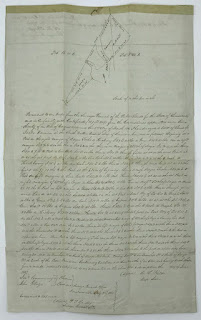
I recently noticed an old Louisiana land document for sale on eBay. It concerned property located near the confluence of Bayou Teche and the Atchafalaya River. (What is called Bayou Teche on this map is today called the Lower Atchafalaya, the Teche now regarded as flowing into the Lower Atchafalaya at Patterson.)

The old Louisiana land document.
(Source: eBay.com)

In other words, the document concerns land near the present-day community of Baldwin, across the Atchafalaya River from present-day Morgan City. 

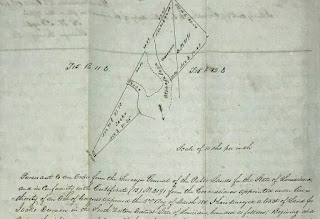
Note the document’s hand-drawn map. Written across parcels spanning both "Bayou Teche" and the Atchafalaya is the name "Jacko Derouen." (Yes, Jacko, as in Michael Jackson’s nickname — though I expect the south Louisiana "Jacko" would have pronounced his name the French way: ZHAH-KO.) Jacko Derouen’s full name also appears below the map, in the actual text of the document.

Close-up of the hand-drawn map.
(Source: eBay.com)

I believe this document answers a question of mine I’ve had for some years: Why in the 1700s was an expanse of land in that region called "Prairie de Jacko"?

From my previous research I knew the toponym appeared in Thomas Hutchins’ 1784 book An Historical Narrative and Topographical Description of Louisiana and West-Florida. In that work Hutchins stated "3 miles below the Tage [Teche] river on the western side is a large savanna known by the name of Prairu de Jacko [Prairie de Jacko]. From this savanna is about 33 miles to the sea."

Page detail from Hutchins' 
An Historical Narrative (1784).
(Source: University of Florida)

Another reference appears on Hutchins’ presumably earlier hand-drawn map of the Teche region. Found not in a Louisiana archives, but in the holdings of the Historical Society of Pennsylvania in Philadelphia, that map — which I believe Hutchins drew between 1779 and 1784 — shows the scrawled placename "Prari[e] de Jacob."

Hutchin's upside-down map (detail).
(Source: Historical Society of Pennsylvania)

The name also appears in the 1779 journal of François Gonsoulin, who, though French in origin, served in Louisiana as a Spanish royal surveyor (the colony having passed from France to Spain in 1762-63). The Spanish government had tasked Gonsoulin, along with local Flemish settler Jean-Baptiste Grevemberg and several enslaved rowers, with exploring the course of the middle and lower Bayou Teche. They would travel downstream from newly founded New Iberia (then called Nueva Iberia) to the bayou’s mouth — a stretch that not only included the present-day Teche below New Iberia, but the waterways now considered the Lower Atchafalaya and the Atchafalaya itself. Even then this was a matter of contention. As I wrote in my 2016 book Teche: A History of Louisiana’s Most Famous Bayou (University Press of Mississippi): 

Indeed, he [Gonsoulin] bristled at those like [colonial leader] Bouligny who called the Lower Atchafalaya "el Rio Grande" or in French "Grand Rivière." They spoke "inappropriately," asserted Gonsoulin in his diary. On the contrary, the great river, he insisted, was "always the Teche."

In my Teche book I also included the below passage about Gonsoulin’s 1779 exploration of the bayou and its distributaries: 

The falua [a type of boat] passed a flat grasslands, which Gonsoulin identified as "la Prairie à Jacob," or Jacob’s Prairie. (This is the same stretch Hutchins had called the Prairie de Jacko and the Prairie de Jacob.) 

Cover of my book Teche.

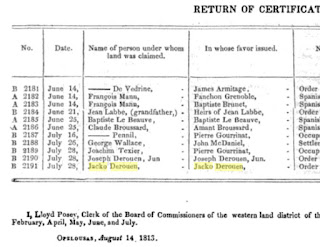
I assume the "Jacko" or "Jacob" mentioned by these early sources is none other than Jacko Derouen. This seems likely, given the peculiarity of the name Jacko: unlike the surname Derouen (commonly found in present-day south Louisiana), the "prénom" Jacko certainly strikes me as unusual, perhaps even unique, for the time and place in question. It could, however, be a diminutive, a corruption, or simply a misspelling of the common name "Jacob" — as the name is indeed rendered by Gonsoulin — or its French equivalent "Jacques." (There is indeed a Jacques Derouen mentioned in early 19th-century historical documents pertaining to south Louisiana.)

Page detail from
the American State Papers (1834)
re: Jacko Derouen’s land in 1813.
(Source: Google Books)

Unfortunately, I know little about Jacko Derouen himself. 

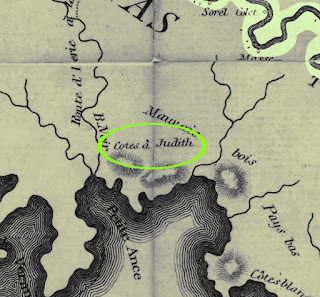
It does seem a little odd that a prairie should bear the first name of a local settler, rather than their surname. This is, however, not the only such instance of this practice. Barthélémy Lafon’s 1806 map of Louisiana, titled Carte générale du territoire d’Orléans comprenant aussi la Floride Occidentale et une portion du territoire du Mississipi, identifies the two salt domes now called Avery Island and Weeks Island as the "Cotes à Judith" (which I would translate as "Hills [Côtes] of Judith" or "Judith’s Hills"). As with "Jacko," I assume "Judith" is a first name.

Regardless, I have never been able to identify the namesake for "Cotes à Judith," and I now wonder if Lafon did not merely garble the surname "Judice." That surname was present in south Louisiana by the 1730s and today is fairly common in the region. Indeed, this solution seems even likelier when one considers that in French, more so than in English, "Judith" sounds remarkably like "Judice."

No doubt there is more out there to be found about these two south Louisiana toponyms.

The "Côtes à Judith"
from Lafon's 1806 map;
Bayou Teche shown at upper right.
(Source: Library of Congress)


Monday, May 1, 2017

Another Civil War Gunboat on the Teche: The U.S.S. Glide, aka Federal Gunboat No. 43

It is well-known that during the Civil War several Union and Confederate gunboats were active on Bayou Teche. These gunboats were the USS Calhoun, USS Estrella, USS Kinsman, USS Clifton, USS Diana (later captured by Rebels and rechristened the CSS Diana), and CSS Cotton. Also present on the Teche was the CSS Stevens (formerly the Hart), which the Rebels scuttled on the bayou between New Iberia and Jeanerette before completion. (See the chapter titled "The Teche during Wartime" in my book Teche: A History of Louisiana's Most Famous Bayou [2016].)

Recently, however, R. C. Sealy of Lafayette sent me a typewritten transcript of a document apparently from the St. Mary Parish Courthouse indicating the presence of yet another gunboat on Bayou Teche — the USS Glide, referred to in the document by its more prosaic name, Federal Gunboat No. 43.


The U.S.S. Glide off Brashear City 
(Morgan City), La., January 1864.
[Note below reader comment from  19 July 2018]

The document in question, authorized by St. Mary Parish Justice of the Peace Barthelmy d'Aquesseau Delahoussaye and St. Mary Parish Clerk of Court Charles Kerr, contains the March 19, 1864, testimony of F. Beaullieu [pron. BOWL-LYOE], agent of George Sallinger of Jeanerette. Beaullieu described himself as “a Frenchman by birth, [who] is disinterested in the matter of the loss of said property.” 

Corroborated by local residents Jules Basille and Pierre Cerf, “both subjects of the French Empire,” Beaullieu recorded that: 
[O]n the night of the 17th of March instant [i.e., that very month] 1864, some person or persons concealed in or near the old warehouse of one Florenz Hamm, late of Jeanerette, . . . fired into the Federal Gun Boat No. 43 as she passed opposite Jeanerette; that said gunboat was on its way to New Iberia; and that when said gunboat returned from New Iberia on the 19th day of March 1864 she landed on the same bank of said bayou [that the gunfire came from], and the officers of the boat under protection of a company of soldiers from on board of said boat sat fire [sic] willingly and deliberately to the house of Mr. George Sallinger, which was consumed to ashes in a few hours, also [with] several other extensive buildings belonging to said Sallinger, to-wit: a large coopers shop eighty feet long by thirty feet wide with double brick chimney; a large warehouse where he kept his barrels, one hundred feet long by thirty wide; another warehouse 50 feet long by 25 feet wide where he kept his hoops and other materials for making barrels; a small house in yard 25 feet long by 15 or 16 feet wide, well finished and in good order; one small kitchen; chicken houses; hen coops; a large quantity of fencing pickets around his premises, 500 to 800 in number; a good mahogany bedstead; a large quantity of cooper's tools, enough to employ 15 to 18 workmen as he generally did; a very large quantity of hoop poles, staves, headings, etc., together with his fruit trees, etc., etc.
Beaullieu added that "he intervened to prevent the Federals from setting the property on fire, but that he was told that the [gun] firing had come from the house of said Sallinger, that they had orders to set it on fire, which they did, and the property was consumed. . . ."

The Washington, D.C., newspaper The Evening appears to refer to this event in a brief article of April 1, 1864, about two weeks after the above incident. Offering a slightly different version of events, The Evening observed, “Rebel guerrillas, at Provost['s] Landing, on the Teche river, fired into one of our gunboats, but fled after a well-directed discharge of grape [shot]. The crew landed and burnt the buildings in the place.” (Provost's Landing, named for the local landowning Provost [pron. PRO-VOE] family, sat on the bayou just upstream from Jeanerette's upper limit at the time.)


Source: Washington, D.C., Evening Star, 1 April 1864, p. 2.

Another newspaper, the New Albany Daily Ledger of Indiana, contained a few more details about the incident. It observed, "A few days ago a company of guerrillas fired into one of our gunboats on the Teche, mistaking the vessel for an unarmed transport steamer. . . . The rebels were concealed in some underbrush, into which a broadside of grape was discharged. The rebels fled on discovering the mistake they had made, taking the killed and wounded, if there were any, along with them. . . . A boat's crew was landed from the gunboat, and the building near the place burned." 


A more detailed account
in the New Albany (Indiana) Daily Ledger,
4 April 1864, p. 1.

(The Daily Ledger identified Provost's Landing as sitting "about twelve miles from Franklin" — which is indeed the approximate linear distance between Franklin and Jeanerette. I asked Mr. Sealy, however, if he knew exactly where along Bayou Teche in Jeanerette the torched structures stood. He matter-of-factly replied “On Cooper Street” — which would make sense.)


Location of the burned cooperage and dwelling
according to Mr. Sealy. Source: Google Maps
(Click to enlarge)

According to the online Dictionary of American Naval Fighting Ships, maintained by the U.S. Navy's Naval History and Heritage Command, the Glide

was a wooden sidewheeler* built at Murraysville, Va., in 1863 and purchased 30 November 1863 at Pittsburgh, Pa., by Rear Admiral Porter. She was converted to Navy use and sent to New Orleans for duty with the Western Gulf Blockading Squadron, Acting Ens. L. S. Fickett in command. . . . From March 1864 to August 1865, Glide served as a blockading ship in Berwick Bay, La. During this period she made numerous short expeditions in the bayous surrounding the bay, suppressing guerrilla activity and capturing small blockade runners. 

Furthermore, the Glide is known to have carried two 32-pounder cannons and four 24-pounder howitzers. 

On August 1, 1865, she was sold in New Orleans at public auction to a buyer named J. W. Young, who used her as a merchant vessel. On January 1, 1869, an explosion destroyed the Glide near New Orleans. As the Louisiana Democrat newspaper reported at the time, “[A]bout forty-nine miles above the city [of New Orleans], she ran aground, and shortly afterwards, between 12 and 1 o'clock, exploded her laboard [port or left-side] boiler, destroying almost every part of the boat" and scalding many of the passengers and crew, some of whom died from their injuries. 


Source: The New Orleans Crescent,
14 January 1869, p. 1.
(Click to enlarge)

Notes

I thank Mr. R. C. Sealy for sharing the document with me that inspired this article. Mr. Sealy informed me that someone gave the document to his wife because she was a descendant of Beaullieu. 

I have corrected and standardized spelling and punctuation in all quoted primary-source material. 

The USS Glide should not be confused with another USS Glide built in 1862 in Shousetown, Pennsylvania, and which also served as a Civil War gunboat.

*As an observant reader commented, the vessel in the photograph at page top is not a sidewheeler, even as the Dictionary of American Naval Fighting Ships describes the USS Glide as "a wooden sidewheeler." At present it is unknown whether the photograph or the Dictionary is incorrect. See, however, the below posting by 1000voices.

Addendum of 11 February 2018:

Nancy Lees found this article, which was reprinted in a New York Times issue of 20 July 1865 (shortly after the Civil War's conclusion). It documents the presence on Bayou Teche of yet another gunboat, the USS Carrabassett. The article reads:


FROM WEST LOUISIANA. 

From the [New Orleans] True Delta, July 11 [1865]. 

The gunboat Carrabassett, six guns, arrived at this port on Thursday evening, from a fifteen months' cruise in the waters of West Louisiana. During her eventful, and at times trying, voyage, she passed through nearly all the bayous, creeks and streams of that portion of our State, at times penetrating to points never before reached by a steamer. 

The report of her operations shows that the Carrabassett has rendered excellent service in the way of capturing arms, ammunition, horses, &c. [etc.]; but her principal service has been in preventing and breaking up the contraband trade which was carried on previous to the removal of trade restrictions, and in this service her efforts proved very successful. 

A month or so ago, information having been sent to the officers of the boat, she proceeded up the Teche Bayou to St. Martinsville, where a large quantity of machinery, belonging to the light-houses on the coast, was found and taken possession of. These light-houses were dismantled some time since by order of Gen. LOVELL, and the fixtures, which are of a very superior description, were taken to St. Martinsville and secreted. The recovery of them comes at a most opportune moment, and will be a saving to the government of about $30,000. The Carrabassett was the first Union gunboat that ever visited St. Martinsville, and was an object of great curiosity to the people. Hundreds of ladies and gentlemen visited the vessel during her stay, and many friendships sprang up between them and the officers. 

The last duty performed by the Carrabassett was convoying transports and carrying troops to Washington [the town in Louisiana] and other points on Bayou Courtableau and Teche. This gave her officers a fine opportunity to see the country and converse with the people, all of whom seemed anxious that the authorities should send a provost-guard at once. The well-known guerrilla, BAILEY VINCENT, has a gang of about a dozen men, who commit the most outrageous acts. The citizens of Franklin have joined with the Federal soldiers in several attempts to capture them, but have failed thus far. This band has several times entered the town of Franklin, robbed the stores, shot into houses, and committed other dastardly acts. When the Carrabassett left Brashear City [now Morgan City] on the morning of the 4th inst., a guard had not occupied Franklin; but, at the earnest solicitation of the citizens, a guard of the Third Rhode Island Cavalry was ordered to leave Brashear for that point on the same day. 

The wrecks of the gunboats Cotton, Diana, Hart and several others, destroyed some two years ago, are still in the Teche, and greatly impede the navigation of that stream. The bridges across this bayou are also destroyed, and the wrecks float about in the water. 

Many of the plantations are in excellent order, with crops in good condition and plenty of laborers. Others are deserted by both proprietors and hands, and are all in ruins. The gunboats in this section are invariably welcomed with demonstrations of joy, as bringing protection from the acts of lawless persons.

SOURCES 

"Another Steamboat Disaster," The Louisiana Democrat, 20 January 1869, p. 3. 

"Battle at Natchitoches, Louisiana — Another Success of the Red River Expedition," New Albany (Indiana) Daily Ledger, 4 April 1864, p. 1.

"From West Louisiana," New York Times, 20 July 1865, p. 2, http://www.nytimes.com/1865/07/20/archives/from-west-louisiana.html, accessed 11 February 2018.

"Glide II (StwStr)," Dictionary of American Naval Fighting Ships, 13 July 2015, https://www.history.navy.mil/research/histories/ship-histories/danfs/g/glide-ii.html, accessed 1 May 2017.

Official Records of the Union and Confederate Navies in the War of the Rebellion, Series II, Volume 1: Statistical Data of Union and Confederate Ships; Muster Roles of Confederate Government Vessels (Washington, D.C. : U.S. Government Printing Office, 1921), p. 96. 

Routh Trowbridge Wilby, Clearing Bayou Teche after the Civil War: The Kingsbury Project, 1870–1871 (Lafayette: Center for Louisiana Studies, University of Southwestern Louisiana, 1991), 28, 30.

Testimony of F. Beaullieu, State of Louisiana, Parish of St. Mary, 19 March 1864, typewritten transcript, 2 pp., photocopy in possession of R. C. Sealy, Lafayette, La.

Sunday, June 5, 2016

Now Available: My New Book about Bayou Teche


Teche: A History of Louisiana's Most Famous Bayou

My newest book, Teche: A History of Louisiana's Most Famous Bayou, has been released by my publisher, University Press of Mississippi. (To order the book from Amazon.com, click here. It's also available from all other booksellers, including local independent booksellers.)


Cover art for my new book.
The painting is by noted south Louisiana
artist Melissa Bonin.

As the book's description reads: 

Shane K. Bernard’s Teche examines this legendary waterway of the American Deep South. Bernard delves into the bayou’s geologic formation as a vestige of the Mississippi and Red Rivers, its prehistoric Native American occupation, and its colonial settlement by French, Spanish, and, eventually, Anglo-American pioneers. He surveys the coming of indigo, cotton, and sugar; steam-powered sugar mills and riverboats; and the brutal institution of slavery. He also examines the impact of the Civil War on the Teche, depicting the running battles up and down the bayou and the sporadic gunboat duels, when ironclads clashed in the narrow confines of the dark, sluggish river.


Image from the (New York) Weekly Graphic (18 April 1874).
Author's Collection.

Describing the misery of the postbellum era, Bernard reveals how epic floods, yellow fever, racial violence, and widespread poverty disrupted the lives of those who resided under the sprawling, moss-draped live oaks lining the Teche’s banks. Further, he chronicles the slow decline of the bayou, as the coming of the railroad, automobiles, and highways reduced its value as a means of travel. Finally, he considers modern efforts to redesign the Teche using dams, locks, levees, and other water-control measures. He examines the recent push to clean and revitalize the bayou after years of desecration by litter, pollutants, and invasive species. Illustrated with historic images and numerous maps, this book will be required reading for anyone seeking the colorful history of Louisiana and the Gulf Coast.


The author (right) canoeing on Bayou Teche.
(Click to enlarge.)

As a bonus, the second part of the book describes Bernard’s own canoe journey down the Teche’s 125-mile course. This modern personal account from the field reveals the current state of the bayou and the remarkable people who still live along its banks.

Saturday, September 21, 2013

A Floating Dancehall on the Teche: The Club Sho Boat

While researching Bayou Teche I learned about a riverboat on the bayou that had been converted into a floating nightclub, dancehall, and restaurant. Christened the Club Sho Boat, it sat on the Teche at New Iberia from the late 1930s to the mid-1950s. (I hesitate to call the vessel a “steamboat,” even though it looked like one, because diesel engines often powered later riverboats. Thus they were not true steamboats.)

The Club Sho Boat on Bayou Teche (ca. 1940).
(Courtesy Angelle-Leigh Breaux)

I did not know, however, exactly where along the Teche the riverboat had been moored.

While driving in New Iberia about a month ago I saw a battered old sign along Main Street. It obviously had been there for decades, even generations, and yet I never before noticed it. The sign stood over the entrance to a grassy lot along the Teche, and its faded letters on a white field read “Showboat Apartments.”

“Showboat?” I thought — might not that be an oblique reference to the Club Sho Boat?

"Showboat Apartments" sign,
1915 E. Main Street, New Iberia, La.
(Photo by author, September 2013)

A short time later I examined a photograph of the Club Sho Boat in the book Looking Back: Historic Images of Iberia Parish. The book credited ownership of the photo to a present-day local photographer. Tracking her down through the Internet, I learned that the Club Sho Boat had belonged to her great-grandfather, a New Iberia entrepreneur named George Angelle. Despite his illiteracy, Angelle had excelled as a businessman, operating not only the Club Sho Boat, but an establishment on Lake Dauterive called George’s Place and another in Hot Wells, Louisiana, named Angelle’s Cafe. He also let rooms there to tourists who came to bathe in the hot springs.

Moreover, I learned that the Club Sho Boat had indeed sat on the Teche at the site of the Showboat Apartments. (Originally used as barracks at Fort Polk, the apartments opened after the Club Show Boat began operation; they are not the same apartments that stand on the property today.)

Former site of the Club Sho Boat.
The gravel at center marks the spot of the boat's slip.
(Photo by author)

Angelle’s great-granddaughter referred me to her mother, who shared with me much of the Club Sho Boat's history. She informed me, for example, that prior to its purchase by her grandfather the vessel had served as a crew boat on Lake Dauterive, perhaps for workers building levees in the Atchafalaya swamp. I also learned that Angelle first moored the vessel in the bayou (as seen in the above image) behind the present-day site of Darby Motors in New Iberia (1305 E. Main Street), then moved it a little downstream into a slip running perpendicular to the bayou (1915 E. Main Street). In addition, Angelle owned a taxi, its door bearing an image of the vessel, that conveyed club goers to and from his establishment.


Interior of the Club Sho Boat, ca. 1940.
(Courtesy Angelle-Leigh Breaux)

Among the musicians who performed at the Club Sho Boat (the vessel’s original name is unknown) were “Cajun swing” artists Happy Fats LeBlanc, Doc Guidry, and their band — known commonly as Happy, Doc, and the Boys, a playful reference to the Seven Dwarfs in the 1937 Disney movie Snow White.

The small building at right served
as the Club Sho Boat's "fish house,"
where fish were stored and prepared for dining.
(Photo by author)

Sadly, Angelle was murdered in 1953 by a Hot Wells landowner with whom he quarreled about cattle trespassing on his property.


Article about Angelle's murder.
(Source: Lubbock [Tex.] Morning Avalanche, 23 May 1953)

After his death Angelle’s family tore down the vessel, razing it to the waterline before filling up the slip with pieces of concrete, dirt, and other debris. According to the family, the hull remains buried in the slip — perhaps awaiting excavation by a future archaeology crew.


The Club Sho Boat from the east bank of Bayou Teche,
by noted Louisiana photographer Fonville Winans.
Winans is the fisherman at left.
(Courtesy www.fonvillewinans.com)

Coincidentally, a friend of mine, eighty-nine-year-old Clarence Barrilleaux (pronounced BEAR-REE-OH in the Cajun French manner) of Avery Island, alerted me to a surviving artifact from the Club Sho Boat. Barrilleaux told me that around 1955 his former employer, Walter S. McIlhenny — president of McIlhenny Company, maker of Tabasco brand products since 1868 — sent him to the Club Sho Boat to pick up its ship’s bell. The riverboat was being torn down at the time, recalled Barrilleaux, and McIlhenny had purchased the salvaged bell as a decoration.

Ship's bell from the Club Sho Boat
as it appears today.
(Photo by author)

Barrilleaux directed me to the bell’s current location on the Island: atop a small wooden tower in a private yard. With permission from the lease holder, I hauled an extension ladder to the bell tower, climbed to the top, and photographed the artifact. The bell is stamped:

CAST.BY.
A.FULTON.
PITTSBURGH

Casting imprint on the ship's bell.
(Photo by author)

According to aficionados of vintage cast bells (there are indeed such persons), bells with this imprint date to 1865 or earlier, subsequent imprints reading “A. Fulton's Son & Co.”* If this is correct, the bell evidently predated the riverboat by many decades, for such vessels had extremely short lifespans because of snags, collisions, boiler explosions, and the like. It seems probable, therefore, that the bell had been recycled any number of times before winding up on the riverboat that ended its life as the Club Sho Boat.


Could one of these features be the ship's bell
as captured by photographer Fonville?
(Courtesy www.fonvillewinans.com)

Addendum of 21 February 2019

Thanks to newly found photographic evidence (see below), we now know the ship's bell sat right in front of the vessel's wheelhouse. (For new information about that vessel's original identity, see the next addendum below.) We can at best, however, only assume this is the same bell now located on Avery Island.


The ship's bell aboard the vessel
that became the Club Sho Boat, ca. 1908.

Click image to enlarge.
(Source: Library of Congress, Washington, D.C.)

Moreover, another artifact of the Club Sho Boat recently came to my attention: the ship's wheel. A friend informed me that the wheel sat in a warehouse along the banks of Bayou Teche just south of New Iberia. With permission of the property owner, we visited the warehouse to photograph and measure the artifact.


The ship's wheel, New Iberia, La.
(Photo by author, February 2019)

Amazingly, the wheel measures 8 feet in diameter. The sheen has long since worn off the wood, but the artifact is in decent shape considering its assumed age of 113 years. We hope to display it in a local museum, thanks to the kindness of the property owner, who has kept the salvaged wheel in storage for many decades.


Presumably the same ship's wheel, 
aboard the vessel that became the Club Sho Boat, ca. 1908.

Click image to enlarge.
(Source: Library of Congress, Washington, D.C.)

Addendum of 20 February 2019

I've found that the original name of the Club Sho Boat was the Wanderer II, a steamboat built in 1906 at Clinton, Iowa, and later converted to diesel. It weighed 140 gross tons (115 net tons), measured 115 feet in length and 24 feet in width, and had a draft of 4.5 feet. Its crew numbered 15. It appears in a U.S. government list of merchant vessels as a “steam yacht.” This designation could stem from the vessel’s noncommercial use by owner Lafayette Lamb “to tow the family houseboat, the Idler” (to cite the University of Wisconsin-La Crosse's Historic Steamboat Photographs Collection, hereafter the HSPC).


The Wanderer II (right, venting steam)
astern the houseboat Idler (left),
St. Paul, Minnesota, ca. 1908.

Click image to enlarge.
(Source: Library of Congress, Washington, D.C.)

The vessel's known crew members were, according to the HSPC: "Tom Garrison (pilot, 1915); Pete Quinn (engineer, 1915); Captain D. W. Gourner (1926); Oscar T. Aucoin (pilot, 1926 [possibly an Acadian or Cajun? — SKB]); William Geisler (chief engineer, 1926); C. M. Bondurant (2nd engineer, 1926)."

The HSPC lists the Wanderer II as “Sold to Standard Oil in 1915 and officially abandoned in November 1933.” At that time or some time afterward George Angelle of New Iberia obtained the vessel for use as the Club Sho Boat. In fact, the HSPC includes a photograph of the Wanderer II moored on Bayou Teche (see below image): although its original name had been stripped from the wheelhouse, a careful examination of the vessel’s landward side reveals a barely perceptible sign — sandwiched between two Coca-Cola advertisements — reading "Angelle's". This suggests the vessel had already become, or was on its way to becoming, the Club Sho Boat.


The Wanderer II becomes the Club Sho Boat on Bayou Teche.

Click image to enlarge.
(Source: Courtesy Murphy Library Special Collections,
University of Wisconsin-La Crosse.
Used with permission.)

Detail of the previous image
showing the "Angelle's" sign.

Click image to enlarge.
(Source: Courtesy Murphy Library Special Collections, 
University of Wisconsin-La Crosse.
Used with permission.)

Another interior photo of the Club Sho Boat, ca. 1940.
(Courtesy Angelle-Leigh Breaux)

Addendum sources:

Bureau of Navigation (Department of Commerce), Forty-Sixth Annual List of Merchant Vessels of the United States . . . for the Year Ended June 30[,] 1914 (Washington: U.S. Government Printing Office, 1914), s.v., "Wanderer II" (p. 323).

Image of the Wanderer II and Idler (detail of image titled "Steamboat landing and Union Station, St. Paul, Minn."), ca. 1908, call No. LC-D4-70671 [P&P] (repro. no. LC-DIG-det-4a22861), Detroit Publishing Company Collection, Prints and Photographs Division, Library of Congress, Washington, D.C., http://www.loc.gov/pictures/item/2016814555/, accessed 20 February 2019.

Image of the Wanderer II (with associated historical data), negative no. 36760, Historic Steamboat Photographs Collection, Special Collections, University of Wisconsin-La Crosse, n.d., https://digital.library.wisc.edu/1711.dl/ZFVIOS7TNYU4V8N, accessed 19 February 2019.

____________________


*“The foundry went under the name Andrew Fulton from 1827 to 1865. . . . At this time they put 'A. Fulton' on their smaller, undated bells. From 1866 to 1889 they went first under the name 'A. Fulton's Son & Co.,' then under 'A. Fulton's Sons & Co.' . . ..” Source: Neil Goeppinger, posting on Americanbell.org, 1 March 2007, http://www.americanbell.org/forum/viewtopic.php?f=4&t=408, accessed 22 September 2013. While I do not know the source of Goeppinger's information, his claims do correspond to data provided by other bell enthusiasts. (I have corrected Goeppinger's punctuation slightly.)

Thursday, May 9, 2013

"Cajuns of the Teche": Bad History, Wartime Propaganda, or Both?

I first learned about the short film Cajuns of the Teche, directed by André de LaVarre and released in August 1942 by Columbia Pictures, while researching my book The Cajuns: Americanization of a PeopleThis find occurred by accident in the late 1990s, while looking for something else in the National Archives and Records Administration. (Serendipity often happens when I’m conducting historical research. I think it’s a perfectly valid form of discovery.)

Title cards from Cajuns of the Teche.
(Screen grabs by author)

In short, a reel of film labeled Cajuns of the Teche sat in the National Archives and had not yet been dubbed to videotape (much less had it been digitized; that technology was not yet at hand for most people). A student at the time, I didn’t have the $250 or so that the National Archives wanted to transfer the film to video, so I contacted my friend, Lafayette attorney Warren A. Perrin. Back then Warren served as president of the Council for the Development of French in Louisiana and owned, as he still does, the Acadian Museum in his hometown of Erath.

Warren agreed to fund the film’s transfer to video through his museum, so I filled out the pertinent paperwork, mailed it off, waited, and a few weeks later a VHS dub arrived from Washington, D.C. I watched the film, found it delightful, but ultimately did not use it as research material for my book. Moving on to other projects, I forgot about the dub for about fifteen years, but recently pulled it out of my files and digitized it so that I can present it here:

(Click to play video)

Two thoughts come to mind when I watch Cajuns of the Teche: First, after seventy years the images are crisp, clear, well-composed, and in my opinion extremely valuable as a record of the Teche region around World War II; second, the narration is often extremely misleading and in some instances downright wrong. 

I’ll catalog these misleading and incorrect claims. The narrator repeatedly refers to the Cajuns’ ancestors as “Arcadians,” when the proper term is “Acadian.” Moreover, the Acadians did not arrive in Louisiana when it was “a colony of the kingdom of France,” as the narrator asserts, but a colony of Spain (albeit one administered for a time by French caretakers — Spain only slowly assumed full control of the formerly French colony).

The scenes of grandiose “Cajun homes” (see timestamps 3:19, 4:45 and 5:13 to 5:21 on the video) never fail to elicit snickers from other Cajuns to whom I’ve shown the film privately. The narration is entirely misleading when it states, “In the past we built many grand and spacious mansions, for our families were large and our attendants were many.” The dwellings in the film were far too luxurious for average, ordinary Cajuns, most of whom lived as subsistence farmers — and who certainly did not have many “attendants” (apparently a euphemism for “slaves”). Granted, a very few “genteel Acadians” managed to rise to positions of wealth in antebellum south Louisiana — mainly sugar planters with enslaved workforces — but they were the exception, not the rule.

Not a Cajun house.
(Screen grab by author)

In addition, the narration refers to the Louisiana colony as “a land with freedom of religion.” While it is true that the Acadians freely practiced their Catholic faith in Spanish-held Louisiana — the Spanish, after all, were Catholics, too — the colony was hardly a bastion of religious toleration. The Spanish, for example, forbid Protestants from holding public worship and they expelled all Jews from the colony.

The “Cajun garden” shown in the film at 5:27 — featuring a centuries-old Buddha statue, if one looks closely enough — is actually Jungle Gardens, owned and operated by Scots-Irish Tabasco sauce manufacturer E. A. McIlhenny (hardly a Cajun).

Some of the narration is drivel. I do not believe, as claimed at 9:47 in the film, that an appreciation of “fine silks and soft satins” represented “one of the strongest traits of French heritage” among Cajun girls. Equally nonsensical is the narrator’s reference at 5:55 — made over the image of fancifully dressed Cajun men and girls enjoying an elegant ring dance — to “slippered steps of old Acadia.” Acadian men and woman alike generally wore moccasins, living as they did on the rugged North American frontier. 

Historically inaccurate Norman milkmaid costume.
(Screen grab by author)

Fortunately, the images themselves are infinitely more valuable than the narration. This is not to say that some of the images are not misleading. For example, the Norman milkmaid costumes worn in the film by some Cajun girls and women (0:45 and 8:05) were unknown to their Acadian ancestors. An example of what anthropologists and other scholars call “fakelore,” these costumes were probably introduced to more upwardly mobile Cajuns through mass-produced, illustrated volumes of Longfellow’s epic poem Evangeline (which follows the fate of an Acadian maiden exiled to south Louisiana). I say “upwardly mobile” because the mass of ordinary Cajuns never read Evangeline.

Circa 1890 depiction of Evangeline.
(Colorized by author)

Criticism aside (at last, you say), I made these other observations while watching Cajuns of the Teche:

The shot of boats moored along a bayou (1:43) seems to show some other waterway besides the Teche, perhaps Bayou Lafourche. I could be wrong — perhaps it is the Teche.

The stern-wheeler shown early in the film (1:50), the V. J. Kurzweg, is despite its appearance not a steamboat. As Carl A. Brasseaux writes in Steamboats on Louisiana’s Bayous, the Kurzweg “is widely — albeit inaccurately — remembered along Bayou Teche as one of the stream’s last steamboats,” but it “was not technically a steamboat” because “it was propelled by diesel motors.” Note the Kurzweg has no towering twin smokestacks as found on most steamboats: as a diesel-powered vessel it did not require them.

The V. J. Kurzweg on Bayou Teche, ca. 1942.
(Screen grab by author)

The fishermen at 2:35 do not seem to be on Bayou Teche, but rather in a cypress swamp. (A bayou is a slow-moving, muddy, usually smallish river, while a swamp is a wooded wetland.) If I had to guess, I would say the swamp in question is the Atchafalaya, if only because of its proximity to the Teche. But there are many patches of swamp in the region that are not in the Atchafalaya. In any event, the swamp in the film was clearly experiencing a flood, as indicated by the swift current.

Sugar cane field workers in Cajuns of the Teche.
(Screen grab by author)

Another scene depicts a mounted white overseer (3:55) supervising a work crew as it weeds young sugarcane shoots. I cannot tell if the work crew is black or white or both. A shot of three male field workers reveals one with black hands (also 3:55), but work gloves mask the race of the other two workers. A wide shot appears to show two white female field workers at far left (4:13). The other field workers in the shot, however, cannot be seen clearly enough to establish their races.

It is tempting to draw a lesson about race or race relations from this scene. But it is impossible to do so without really knowing the workers’ racial makeup. Regardless, the shot does illustrate the region’s dependence on manual field labor in 1942. It would take the ongoing war and resulting labor shortages to spur south Louisiana agriculture to mechanize. What I observed about rural Lafayette Parish in The Cajuns no doubt held true for much of Cajun Louisiana: Despite the findings of a 1942 survey “that ‘tractors are not thought to be necessary or even desirable,’” Lafayette parish farmers “had almost universally adopted mechanization within a decade. ‘The old days of the plow and the horse are gone,’ observed a 1951 survey.”

A ring dance on the banks of the Teche.
(Screen grab by author)

The reference to “giant spiders” (4:09) alludes to the legend of the Durand wedding, which allegedly occurred at Oak and Pine Alley on the outskirts of St. Martinville. As journalist Jim Bradshaw records:
It was only to be expected that [Durand] would throw the finest wedding ever when two of his daughters decided to get married on the same day. . . . [A]s the romantic legend is told, he ordered a million spiders sent from China and sent couriers to California to fetch hundreds of pounds of silver and gold dust. (A less romantic version of the story says the spiders came from nearby Catahoula Lake, but I like the China version better.) . . . Shortly before the wedding day, the spiders were set loose to spin millions of yards of delicate webs among the limbs of the oak and pine alley. On the morning of the wedding, servants armed with bellows filled with the silver and gold dust sprayed the cobweb canopy to set it glittering in the sunlight like something from a fairy tale.
Of this legend Brasseaux states, “Most southern Louisianians are familiar with the stories of the spiders imported from China for the Oak and Pine Alley wedding.” Yet it along with similar local legends, he notes, have been “proven unfounded by recent historical research.” (To Bradshaw’s credit, he concurs with Brasseaux that the story is a legend.)

Elsewhere, the narrator observes (6:08) “We Cajuns speak French among ourselves, and some of our children do not learn English until they reach the classroom.” Where they will have the French whipped out of them, I thought. I was being only slightly facetious, for south Louisiana educators often punished Cajun children for speaking French at school. More than any other factor, this practice accounted for the rapid decline of Cajun French during the early to mid-twentieth century. (See my previous blog article about tracking this decline.)

Quilters with garde-soleils.
(Screen grab by author)

Finally, although the Cajuns’ dress is not “authentic” (that is, historically accurate) in the spinning wheel scene at the beginning or in the ring dance scene, the clothing shown in other scenes does strike me as authentic.  See, for example, the field workers (Cajun or otherwise) shown from 3:55 to 4:29; and the school children from 6:05 to 6:24. (Note the students in question attended an all-white school: segregation did not end in much of Louisiana until 1969 — about fifteen years after the U.S. Supreme Court case Brown v. Board of Education struck down separate-but-equal schooling nationwide.) See also the churchgoers at 6:38 and 6:45; the corn husk weavers at 7:05; and the quilters at 7:42 (complete with their garde-soleils, or sunbonnets). In addition, see the weaver at right, but not at left, at 8:04, and, conversely, the same weaver at left, but not at right, at 8:10; and the wedding goers at the end of the film (9:40 onwards). The apparel in these scenes looks very authentic to me. Perhaps the subjects had no time or compulsion to dress for the camera?

Horse and buggies leaving Cajun wedding.
(Screen grab by author)

Now to address an issue other than the film’s accuracy: Was the film wartime propaganda?

I found Cajuns of the Teche in the National Archives collection of the U.S. Information Agency (USIA). Founded in 1953 during the Cold War and still active today, the USIA, as its website notes, “explains and supports American foreign policy and promotes U.S. national interests through a wide range of overseas information programs . . . [and] promotes mutual understanding between the United States and other nations by conducting educational and cultural activities.” Created prior to the advent of the USIA, Cajuns of the Teche sat in a section of the USIA collection regarding an earlier organization, the U.S. Office of War Information (OWI). Established in 1942, the OWI, as the Library of Congress explains, “served as an important U.S. government propaganda agency during World War II.”

Logos of the USIA and the OWI.

Why would a travelogue film issued by Columbia Pictures be found in a collection pertaining to the OWI?

The answer might be found in a pictorial “feature” (pre-packaged photo essay for overseas consumption) issued by the OWI in 1944 and titled “The Bayou French of Louisiana.” This feature consisted of a four-page typewritten essay about the Cajuns along with many captioned black-and-white still images. These photos depicted “everyday” Cajun culture, activities, and places. 

Intriguingly, at least four of these black-and-white still images depict events also shown in Cajuns of the Teche. Moreover, these black-and-white images were clearly shot at the exact same moment as the corresponding images in the film — albeit from slightly different angles. See the below image comparisons: Those at left are “screen grabs” from Columbia Pictures’ Cajuns of the Teche, while those at right are still images from the OWI's “The Bayou French of Louisiana.” As you can see, the paired images are almost identical (click to enlarge):


The OWI’s “The Bayou French of Louisiana” was clearly wartime propaganda. Its purpose was to show overseas audiences how American society could support an ethnically heterogeneous population, yet still be undeniably “American.” As the OWI essay accompanying the images put it, “The persistence of Cajun French traditions in the United States, as those of other national groups, is encouraged in the belief that such diversity enriches and strengthens democratic institutions. The various population groups of the United States are encouraged to perpetuate their folkways so that each may contribute to the homogenous but broadly variegated culture of the United States.”

But was the earlier Cajuns of the Teche also wartime propaganda? 

The federal government created the U.S. Office of War Information in June 1942; Columbia Pictures issued Cajuns of the Teche the next month. This would hardly seem enough time for the fledgling OWI to produce an eleven-minute film shot on location in south Louisiana and to arrange for a major Hollywood studio to distribute it. And while there are examples of the OWI and Columbia Pictures teaming up later to release wartime propaganda films (such as the 1943 film Troop Train and the 1945 film The True Glory), there is no known evidence of OWI involvement with Cajuns of the Teche.

Back of OWI print indicating when and
from whom it had been purchased.
(National Archives and Records Administration,
Washington, D.C.)

A key to understanding the actual, tenuous relationship between the OWI’s propagandistic “The Bayou French of Louisiana” and Columbia Pictures’ Cajuns of the Teche may be found on the back of the original B&W prints used with “The Bayou French of Louisiana.” Data there indicates that the OWI licensed the images from a commercial entity named “Screen Traveler, from Gendreau.” Presumably a stock photo vendor, Screen Traveler may have sent a photographer to Louisiana in 1942 alongside Columbia Pictures’ film crew. This would explain why some of the images in Cajuns of the Teche and some of those in “The Bayou French of Louisiana” correspond so closely.

Ultimately, I do not believe — given the current evidence — that Cajuns of the Teche was a product of OWI wartime propaganda; but I do believe that still photographs taken during the filming of Cajuns of the Teche ended up in the wartime propaganda project “The Bayou French of Louisiana.” I make this assertion because we know for certain that the OWI, a government entity charged with producing wartime propaganda, issued “The Bayou French of Louisiana”; and we know that some of the images used in “The Bayou French of Louisiana” closely match scenes in Cajuns of the Teche.

Still, the question remains: why is there a reel of Cajuns of the Teche in the OWI section of the USIA's archival collection?